Home › Kitchen › Best Magnetic Spice Rack
Best Magnetic Spice Racks for the Fridge, Ranked Honestly
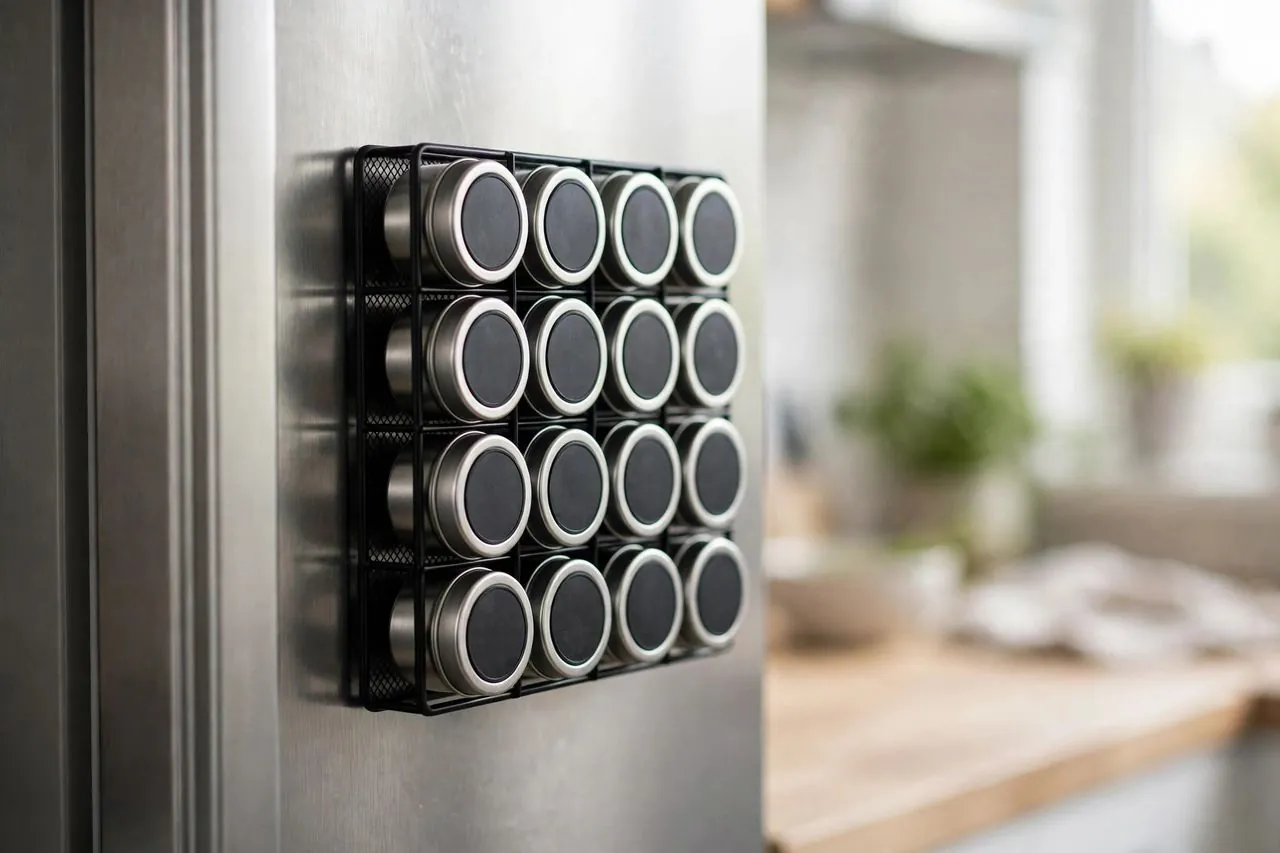
The best magnetic spice rack for your fridge is a wide, flat-backed shelf with a guard rail, but only if your fridge passes a simple magnet test first. Many stainless fronts are barely magnetic, so test before you buy, load well under the stated limit, and mount on the side away from stove steam.
In a hurry? Start with the first pick in the table below — it is the one most renters should look at first. Check Price on Amazon
If your spices live in a cupboard avalanche, I understand, because that is where almost every renter starts. You open the door, you move three jars to find the cumin, one jar falls over, and dinner begins with a small sigh. The side of your fridge is probably standing right there, empty, flat, and doing nothing. A magnetic spice rack turns that dead panel into the calmest storage in your kitchen, with no drill, no adhesive, and nothing to explain to a landlord later. This page is part of our Kitchen hub, and it sits alongside our wider no-drill storage guides, because the same thinking applies everywhere in a rental: use the surfaces you already have, and leave every one of them untouched.
But I want to be honest with you before I show you a single pick, because this is the product category where honest advice matters most. Magnetic racks are wonderful on the right fridge and useless on the wrong one, and the difference is invisible until you test it. So this guide works in a deliberate order. First, the picks, because you may have come here ready to choose. Then the magnet test, the measuring, and the simple weight maths that decide whether any pick will actually stay up in your kitchen. Please do not skip that section to save two minutes. Those two minutes are the difference between a spice wall you love and a rack on the floor at midnight.
If you already know your fridge holds a magnet firmly and you want the short answer, start with the wide guard-rail shelf below. It is the style I would hand to most renters, most of the time.
The quick decision table
Read the catch column first. Every style here is good at one job and quietly bad at another, and the catch that bothers somebody else might not bother you at all, while the one nobody mentions might be the one that ruins it in your kitchen. Match the catch you can live with, not just the feature you like.
| Pick | Best for | Type | Key constraint | The catch |
|---|---|---|---|---|
| Wide guard-rail shelf | Most renters | Shelf rack | Needs a firmly magnetic flat panel | One row only, so big collections outgrow it fast |
| Single magnetic tins | Tiny collections | Individual tins | Each tin needs its own clean contact spot | Constant refilling if you buy spices in bulk |
| Stacked shelf set | Big collections | Multiple shelves | Needs a large clear side panel | Takes the whole fridge side and tempts overloading |
| Deep basket shelf | Tall bottles and oils | Basket shelf | Heavy loads must sit low on the fridge | Becomes a junk drawer if you let it take every job |
| Slim single-row rack | Narrow side gaps | Slim rack | Clearance with doors fully open is tight | Holds only your true daily spices, nothing extra |
| Rack with hooks and bar | Small kitchens needing a station | Shelf plus hooks | Hooks suit light items only, never heavy tools | Can look cluttered and catch sleeves in walkways |
This is for you if
You rent, you cook often enough that spice hunting genuinely slows you down, and your fridge has a flat side or front panel that holds an ordinary magnet firmly. It is also for you if you are setting up a first small kitchen and want storage that can move house with you in a single box, and if you would rather spend once on a system you can rearrange than keep buying little organisers that solve half the problem. If your kitchen is part of a bigger organising project, our renter-friendly kitchen organization guide and our roundup of the best no-drill shelves will help you plan the rest of the room in the same spirit.
Skip magnetic storage if
Your fridge fails the magnet test in every spot, your only free surface is curved, textured, or covered by a handle, or your spice buying habit is big bulk bags that would live in tins for a week before needing a refill. Also skip it, honestly, if you know a visible wall of jars will stress you out. Some people cook calmer with everything hidden, and a tiered stand inside a cupboard will serve those cooks better than any pick on this page. There is no shame in that answer. Good storage fits the cook, not the photograph.
The six picks, ranked for renters
A note on how to read these picks. I am recommending styles and formats, and teaching you exactly which details on the pack to check, rather than pretending a listing photograph tells us how a rack will behave on your particular fridge. Magnet grades, load figures, and included pieces vary between sellers and change over time, so the checks under each pick are the part to carry with you when you shop. That is the same approach we take across DrillFree Nest, and you can read more about it in the kitchen section of our small apartment guides.
Best for most renters: Wide Magnetic Shelf Rack With a Raised Guard Rail
If I could only point one friend toward one style, this is the one I'd point to. It's a flat-backed metal shelf, or a short stack of two, that presses straight onto the side or front of your fridge and holds a single row of standard spice jars behind a raised front rail. The rail matters more than it looks. Every time your fridge door swings shut, everything on that fridge vibrates a little. A rail gives a jar somewhere to stop, instead of a slow walk toward the edge over a week of door slams.
Why it works for renters is simple. There's no adhesive to cure, no strip to peel off a wall, and no bracket left behind. You press it on, you load it, and on moving day you lift it off and put it in a box with the mugs. It also moves with you in a smaller way, week to week. If you realise the rack sits too close to the stove and catches steam every time you boil pasta, you slide it six inches down the side panel and the problem is gone. Try doing that with a screwed wall rack.
The rules I'd teach anyone buying this style are these. First, look for a wide, flat magnetic back rather than two small round magnets at the corners. More contact area means more hold and less sideways sliding. Second, check what the pack itself says about load capacity, and then plan to use well under that number, because makers test on clean, thick, perfectly flat steel and your fridge may be thinner, slightly textured, or a little greasy near the stove. Third, check the backing material in the listing photos. A rubberised or padded back protects your fridge finish and grips better than bare hard metal dragged across paint.
Load it in the order that protects you. Heaviest jars go on the lowest shelf and closest to the centre, lightest jars go up top. Put the spices you use daily at the front of the row where your hand lands naturally, and put the once-a-month spices, the cream of tartar and the whole nutmeg, at the back or on a higher shelf. Label the lids, not just the fronts, because on a side-mounted rack you'll often be looking down at your collection from above while you cook.
The honest downside is width. A guard-rail shelf holds one row well. The moment you try to double-stack jars or squeeze a second row behind the first, you've defeated the whole idea, because now you're digging again, just on your fridge instead of in a cupboard. It also won't hold tall oil bottles or big supermarket spice tubs safely, and it shouldn't try. This is a home for standard jars, not for your whole pantry.
Who should skip this one:
Skip this one if your fridge failed the magnet test I'll walk you through below, if your only free surface is the curved front of a rounded door, or if your spice collection is mostly oversized tubs and bottles. You'll be happier with the tin set or the deep basket further down this page.
Best for a tiny collection: Single Magnetic Spice Tins, Bought as a Set
Single tins are the original fridge spice idea, and for a small collection they're still the most flexible option here. Each tin carries its own magnet on its base, sticks where you put it, and comes away in your hand when you need it. There's no rack, no shelf, and no fixed shape to work around. You can arrange twelve tins in a neat grid on the fridge front, spread them in a long line down the side, or split them, with everyday spices by the stove and baking spices near the counter where you mix.
That freedom is the real product. A rack decides your layout for you. Tins let a shared kitchen work, too, because one person can keep their chilli flakes and smoked paprika in their own little cluster and a housemate can keep theirs somewhere else. When you move, the tins are already packed containers. You just stack them in a box and they travel as they are.
Here's what to check on the pack before you buy, because tins vary more than they look. Check the lid style. A clear lid helps you spot cumin versus ground coriander at a glance, which is a genuine daily saving, but check that the lid seals firmly, because a loose lid on a tin you pull off a fridge every day will eventually dust your floor with paprika. Check whether the set includes labels, and whether those labels go on the lid or the side, because that decides how you should arrange the tins. Check the stated size of each tin in plain terms against how you buy spices. If you cook with one spice constantly, a small tin means constant refilling from a bag that now needs a home somewhere else, and you've moved your clutter rather than removed it.
One more rule that nobody tells you until they've learned it the hard way. Fill tins over the sink or over a tray, with a small funnel if the set includes one. Decanting ground spices from a wide shop jar into a small tin is the single messiest minute of this whole project, and it's a minute you'll repeat, so set it up kindly for yourself from the start.
The downside is the refill habit itself. Tins reward cooks who buy small amounts often and punish cooks who buy big bags. And because each tin depends on its own single magnet, a tin that's overfilled, greasy on its base, or stuck over a fridge seam or handle curve is the one most likely to slide. Wipe the bases when you refill. It's a ten-second job that does most of the work of keeping them put.
Who should skip this one:
Skip this one if you hate decanting, if you buy spices in bulk, or if small children will treat a fridge front full of colourful tins as a puzzle to rearrange daily. A lidded shelf rack will keep your sanity better.
Best for a big collection: Stacked Multi-Shelf Magnetic Rack Set
If your spice collection has outgrown a cupboard shelf and a drawer, a set of several matching magnetic shelves is how you turn a whole fridge side into a proper spice wall. Instead of one long rack, you get multiple shelves you can stack in a column, stagger at different heights, or split between the side panel and the front of the fridge. Bought as a matched set, they look deliberate, and that matters more than we'd like to admit, because storage you find ugly is storage you stop maintaining.
The planning rule for a set is zones, and I'd urge you to plan before a single shelf goes up. Everyday cooking spices at hand height, in the middle. Baking spices together on one shelf, because they're used together, at the same counter moment, usually with flour already on your hands. Blends and rubs on another shelf. Rarely used spices highest, where a small step or a stretch is acceptable. When each shelf has a job, you stop scanning thirty jars and start scanning eight, and dinner gets calmer.
Now the caution that comes with scale. Every shelf you add is weight your fridge surface has to hold through thousands of door closures. Spread a set across the surface rather than clustering all of it in one corner, keep the heaviest shelf lowest, and load a new set gradually over a few days rather than all at once on the first afternoon. That gradual loading isn't fussiness. It's how you find out, gently and with one jar, that a particular spot on your fridge, perhaps over a seam or a slightly bowed panel, holds less well than the rest, instead of finding out all at once at midnight.
Check on the pack how many shelves you actually get, whether they are all the same size or a mix, and whether any hooks or rails are included or are just shown in the photos. Listing photos for sets are famously generous, showing kitchens loaded with extras that aren't in the box. Read the contents line, not the picture. And measure your fridge side and sketch your column on paper first, because a set that fits the width can still collide with a door handle, a hinge, or the wall beside the fridge when the door opens fully.
The honest downside is commitment of surface. A full spice wall takes your fridge side out of service for everything else, the kids' drawings, the takeaway menus, the magnetic poetry, and it puts a lot of glass at the exact height where bags and boxes get carried past in a busy kitchen. It's also the option most likely to be overloaded, simply because there's always one more jar that almost fits.
Who should skip this one:
Skip this one if you rent a small fridge with a narrow side panel, if your fridge sits tight against a wall with only the front free, or if you know you'll never keep zones tidy. One honest shelf beats four shelves of chaos.
Best for tall bottles and oils: Deep Magnetic Basket Shelf for Bottles
Not everything you reach for while cooking comes in a standard spice jar. Vinegar, chilli sauce, soy, a small bottle of oil, the tall grinder that fits nowhere, these are the bottles that live on the counter because no spice rack will take them. A deep magnetic basket shelf is built for exactly that awkward group. The basket walls are higher, the base is deeper front to back, and the whole thing is meant to cradle bottles rather than line up jars.
Used well, this is the pick that clears your counter, not just your cupboard. Put it on the fridge side nearest your prep area, keep the two or three bottles you use daily in it, and give the counter back to actual cooking. It also makes a kind home for non-food clutter that migrates to kitchens, a small plant, a roll of paper towels on some designs, or the tin of tea that never had a cupboard of its own.
The rules here are stricter, because bottles are heavy in a way jars aren't. A full glass bottle carries its weight high, which makes it tippy and makes it pull outward on the shelf as well as down. So check the basket depth against your tallest daily bottle, check what the pack says about load, and then stay well under it, and keep this shelf low on the fridge where a failure, if one ever happens, drops a bottle inches onto a counter rather than feet onto a floor and a foot. Never put your one expensive oil or a glass bottle you can't replace in a magnetic basket until the shelf has held your everyday bottles happily for a week or two. Earn trust in stages.
Also think about heat, and I'll return to this below because it matters for every pick on this page. Bottles of oil belong away from the stove side of the kitchen if you can manage it. Warmth ages oil faster, and the side of a fridge that stands next to a busy hob can be a warm, steamy place. If your only fridge surface faces the stove directly, keep oils in the cupboard and use this basket for sauces, tools, and packets instead.
The downside is that a deep basket tempts you to store by dumping. Bottles go in, then packets go in on top, then a stray utensil, and within a month it's a fridge-mounted junk drawer. Give it one job, bottles only, and it will stay the most useful shelf in your kitchen. Let it take every job and it will do none of them.
Who should skip this one:
Skip this one if your fridge side is narrow, because deep baskets need door swing clearance too, if your bottles are mostly huge family sizes, or if your fridge failed the magnet test in the exact spot where this would need to live. Weight plus a weak surface is the one combination this whole page is trying to keep you away from.
Best for narrow side gaps: Slim Single-Row Magnetic Rack
Some kitchens give you almost nothing. The fridge is wedged between a wall and a counter, and the free strip of its side is only a few inches of visible metal that you can actually reach. A slim single-row rack is made for that strip. It's the narrowest format here, a single line of jars held close to the surface, adding storage where even a standard shelf would block a cupboard door or catch on everything that passes.
What I like about the slim format is how honest it forces you to be. It holds your true daily spices, the eight or ten you actually cook with, and no more. In a tiny kitchen that limit is a gift. The rest of your collection can live in one box in a cupboard, clearly the backup box, instead of thirty jars fighting for the good spot. Many cooks quietly discover their cooking gets simpler and better when the daily set is small and visible and the rest is out of the way.
Before you buy, do the clearance check I'll detail in the how-to-choose section, and do it with the fridge door and the neighbouring cupboard door both fully open, because slim racks fail on clearance more than on magnets. Check the rack depth on the pack, add the depth of your jars, and compare that total against the gap the rack will live in. Check, too, whether the rack suits the jar shape you own. A single row designed around round tins may not cradle square shop jars, and the other way around. Your jars decide the rack, not the listing photo.
Mounting position deserves a thought as well. On a narrow strip, eye level is tempting, but the most reachable spot is often slightly lower, where your hand falls while you're at the counter. Put your most-used spice at the end of the row nearest the stove, your least-used at the far end, and leave the tiniest bit of breathing room between jars so you can grip one without knocking its neighbour forward.
The honest downside is capacity, obviously, but also fiddliness. A single row is a precision format. Jars go back in their places or the row stops working, and households that cook in a cheerful hurry may find that discipline annoying by week two. It also offers nowhere for oils, packets, or odd shapes, so it solves one problem only, though it solves that one beautifully.
Who should skip this one:
Skip this one if you have a wide, empty fridge side going spare, because you're paying slim-format prices for storage you don't need to ration, or if your household shares cooking and everyone's daily eight is different. A wider shelf set will cause fewer arguments.
Best for hooks and extras: Magnetic Rack With Detachable Hooks and a Towel Bar
The last style is the multitasker, a magnetic shelf or two with detachable hooks underneath or alongside, and on some designs a bar for a towel or a roll of kitchen paper. For a renter in a truly small kitchen, this format earns its place because the fridge side stops being only a spice address. Spices live on the shelf, measuring spoons and scissors hang from the hooks, and the towel that used to live on the oven handle, getting damp and in the way, finally has a home of its own.
Hooks change the physics a little, and it's worth understanding why. A jar on a shelf presses down through the shelf. A tool on a hook swings, and swinging weight tugs outward in small repeated pulls every time the fridge door moves. So keep hooks for genuinely light things, spoons, a small whisk, oven gloves, a towel, and never hang a cast iron anything, a heavy utensil crock, or a bag of shopping, however briefly. Briefly is exactly how accidents describe themselves afterwards.
Check on the pack whether the hooks are fixed or detachable, and whether they slide along a rail or clip in one place only. Detachable, sliding hooks are worth preferring, because the right spacing for a towel is wrong for measuring spoons, and your needs will change. Check whether the towel bar, if there is one, is part of the shelf or a separate magnetic piece, because a separate piece gives you a second placement decision and a second magnet test to pass. And check the hook material and finish in the photos for a padded or coated back on the main shelf, for the same scratch-protecting reason as every other pick here.
Plan this one as a small station, not a shelf. Spices above, tools below, towel to one side, and a clear rule that nothing else joins the station without something else leaving it. Stations like this are where small kitchens are won, one deliberate square foot at a time, and they're also where small kitchens are lost, one extra dangling gadget at a time.
The downside is visual and practical clutter risk. This is the pick most likely to end up looking like a market stall, and every dangling item is one more thing to catch a sleeve or a bag strap as you pass. If your fridge side is on a walkway, keep the hooks high and the hanging items short, or choose a plainer shelf and put your hooks somewhere safer.
Who should skip this one:
Skip this one if your fridge stands in a tight corridor kitchen where people squeeze past it all day, if you know hanging tools will annoy you, or if your lease or your own taste says the fridge should stay calm and clear. Simple shelves will suit you better, and there's no prize for choosing the busiest option.
How to choose: the test, the tape measure, and the jar maths
Step one: the fridge magnet test
Take an ordinary fridge magnet, the flat souvenir kind is perfect, and press it to the exact panel where your rack would live. Not a similar panel, that exact one, because the front and side of the same fridge can be different materials. Leave it there while you make a cup of tea. Then tug it gently downward and try to slide it sideways. A magnet that stays put, resists the tug, and needs a deliberate pull to remove is telling you the surface can probably hold a rack. A magnet that creeps, tilts, or slides is telling you the truth too, and you should believe it the first time.
Repeat the test in every spot you are considering, high and low, front and side, and near any seam or edge. Then, if you buy a rack, repeat the logic at a larger scale. Put the empty rack up, tug it, leave it overnight, and only then load it a few jars at a time over a couple of days. Gradual loading feels slow. It is also how you learn your fridge's real limits with one jar at risk instead of twenty.
Why stainless steel catches so many people out
Stainless sounds like one material, but it is a family of them. Some grades contain enough iron in a magnetic structure that magnets grip well. Other common grades, often used on smart-looking fridge fronts and fingerprint-resistant finishes, are barely magnetic at all. The fridge can be real steel, expensive, and beautifully made, and still refuse to hold a spice tin. That is why no honest guide can promise you a rack will work on stainless, and why the two-minute test beats every review, including this one. If your stainless front fails, check the side panel before giving up. Sides are sometimes a different, more magnetic material than the showpiece front.
Step two: measure side clearance properly
Measure the width and height of the free panel, then measure the things listings forget. Open the fridge door fully and watch where it travels, because a rack that fits with the door closed can block it opening past a counter. Open the neighbouring cupboard doors too. Measure the gap between the fridge and the wall or units beside it, and compare that gap against the rack depth on the pack plus the depth of your jars. If the total is close to the gap, people squeezing past will knock your jars daily, and a slimmer format belongs there instead. Finally, keep racks clear of any vents your fridge manual points out, and leave breathing room at the top and bottom of the panel.
Step three: jar-weight maths in plain words
You do not need to be precise. You need to be roughly right and comfortably under. Put your filled jars, one typical jar will do, on a kitchen scale and note the weight. Multiply by the number of jars the rack will carry. Then add the weight of the rack itself, which the pack or the delivery listing should state, and if it does not, weigh it when it arrives before loading it. Compare your total with the load figure the maker states for that rack. Your total should sit well below it, not near it, because the maker's figure was earned on perfect steel in a still room, and your kitchen has door slams, warmth, and cooking air. If the maths only works when every jar is half empty, the honest answer is a second shelf or a smaller daily set, not hope.
While you are measuring, look at your wider kitchen with the same eyes. Renters often find the fridge is only the first dead surface in the room, and our guides to over-the-door organizers and peel-and-stick upgrades can help you claim the rest of it just as safely.
Mistakes and red flags: what not to buy
The first red flag is a listing with no stated load figure at all. A maker who will not tell you what a magnetic rack holds is asking you to find out with your own jars and your own floor. The second is a rack held by two small round magnets at the corners with a wide empty span between them. That design slides sideways, sags in the middle, and protects nothing. Look for broad, flat magnetic contact instead. The third is bare, hard, sharp-edged metal on the back of a rack with no padding mentioned or shown. On a rented fridge, that backing is a scratch waiting for its moment.
Walk away, too, from any rack whose photos show it carrying loads it plainly should not, stacked oil bottles, heavy tins piled two deep, a small plant pot on top for decoration. Photos like that tell you the seller is selling a picture, not a working limit. Be wary of sets where the contents are unclear, where hooks, bars, and extra shelves appear in every photograph but the written contents list is vague. Count what the words promise, never what the pictures show.
The common buying mistakes are quieter. Buying before testing your fridge is the biggest, and it is why this page keeps returning to a two-minute magnet test. Buying for the collection you wish you had, forty jars deep, instead of the one you cook with is the second. Overloading in the first hour is the third. Mounting in the steam path above or beside a hob, so every jar lives in a warm damp cloud, is the fourth. And dragging a loaded rack sideways to adjust it, grinding whatever dust sits behind it across your fridge finish, is the fifth. Every one of those mistakes is avoidable, and none of them needs any skill to avoid, just a slower first day.
Removal and your deposit: the easiest section on this site
Here is the lovely truth about this whole category. There is nothing to remove. No adhesive to soften, no strip to pull, no hole to fill, no paint to match, and no awkward conversation at inspection. When you move, or when you simply want your fridge back, you lift each rack straight off the surface, wipe the panel with a damp cloth to lift any spice dust or faint ring of kitchen grime that gathered around the edges, dry it, and you are done. The fridge looks as it did on the day you arrived, because nothing was ever attached to it in any way that leaves a trace.
That zero-damage quality is why magnetic storage sits at the very top of our renter recommendations, ahead of even the gentlest adhesive. Adhesive done well is deposit-safe too, and our deposit protection guide explains how to handle every removable method in your home, but magnetic storage does not even ask you to do it well. It asks you to lift rather than drag, and to keep the surface clean underneath, and that is the complete list. If you share your home with someone who worries about the deposit, this is the page to show them, along with our bathroom guide to renter-friendly bathroom storage, which uses the same leave-no-trace thinking in a harder, steamier room.
One small habit protects you completely. Photograph the fridge panel before your rack goes up and again after it comes down at the end of your tenancy, with the date visible in your phone as phones naturally record it. You will almost certainly never need those photos. Having them costs you thirty seconds and turns any question about marks into a calm, short conversation.
Frequently asked questions
- Will a magnetic spice rack work on a stainless steel fridge?
- Maybe, and that maybe is the most important word on this page. Many stainless steel fridge fronts are made from a grade of steel that magnets barely grip, so a rack that holds beautifully on a painted fridge can slide straight off a stainless one. Test the exact spot with an ordinary fridge magnet first. If it holds firmly and resists a gentle sideways tug, a rack has a fair chance. If it slides, no rack will fix that, and you should choose a different storage spot.
- How do I test whether my fridge is magnetic enough?
- Take a small fridge magnet and press it to the exact surface where the rack would live, not a different panel. Leave it for a minute, then tug it gently downward. A firm hold that takes a deliberate pull to remove is a good sign. A hold that creeps, tilts, or slides under a light tug is a warning. Repeat the test in two or three spots, because the front, the side, and the area near a seam can behave surprisingly differently on the same fridge.
- Will a magnetic spice rack scratch my fridge?
- It can, if grit is trapped behind it or if you drag a loaded rack sideways across the finish to adjust it. Protect yourself with three habits. Wipe the surface clean before the rack goes on, choose a rack with a padded or rubberised back when you can, and always lift a rack fully off the surface to move it rather than sliding it. Lifted and replaced cleanly, a magnetic rack should leave your fridge exactly as it found it, which is the whole point for a renter.
- How much weight can a magnetic spice rack hold?
- Only the pack for the exact rack you are buying can tell you its stated limit, and even then you should plan to stay well under it. Makers test on clean, flat, thick steel in still conditions, while your fridge has vibration, warmth, and a little cooking grease in the air. Weigh your filled jars on a kitchen scale, add the rack itself, and keep your real total comfortably below the stated figure. If a listing gives no limit at all, treat that silence as your answer and choose another rack.
- Should I mount my spice rack on the front or the side of the fridge?
- The side is usually the better home. It keeps jars out of the main walkway, away from most door swing drama, and close to the counter in many layouts. The front suits single tins and very slim racks, and it is the only option when the sides are blocked, but everything on the front gets bumped, brushed, and stared at. Whichever you choose, open and close the fridge door a few times with the rack empty before you load it, and watch what moves.
- Is it safe to store spices next to the stove on the fridge?
- Spices prefer cool, dry, and dark conditions, and the fridge side nearest a stove can be warm and steamy, especially during long cooking sessions. Steam is the bigger enemy, because moisture finds its way into jars and clumps ground spices. If your fridge stands right beside your hob, mount the rack on the far side or low on the front, away from the rising steam path, and keep lids closed firmly. Herbs and ground spices you use slowly deserve the coolest spot you can give them.
- Why does my magnetic rack keep sliding down?
- Sliding usually has one of four causes. The surface is a weakly magnetic grade of steel, the rack is loaded beyond what that surface can hold, grease or dust is breaking the contact between magnet and metal, or the load is uneven with heavy jars pulling one end down. Clean both surfaces, lighten the load, move the heaviest jars to the centre or a lower shelf, and retest in a different spot. If it still slides after all that, believe your fridge and choose a different kind of storage.
- Can I use a magnetic spice rack on the fridge door itself?
- You can on some fridges, but think it through first. The door is the most disturbed surface in the kitchen, opened and closed all day, and everything on it rides that movement. Slim racks and single tins cope best there. Deep shelves and heavy bottle baskets belong on the steadier side panel instead. Check also that a rack on the door will not stop the door sealing properly or collide with a counter when the door opens fully. Clearance problems only announce themselves after you have loaded everything, so test empty.
- What jar size works best on a magnetic spice rack?
- Standard small spice jars are the natural fit for shelves and slim racks, because they sit in one tidy row with their labels facing you. Very tall jars can be too top heavy, very wide tubs waste the row, and square jars suit some racks better than round ones. Before buying a rack, line up the jars you actually own on a counter in one row and measure the row. That simple measurement, plus the depth of your deepest jar, tells you more than any listing photograph ever will.
- Will strong magnets damage my fridge or its electronics?
- Household magnetic racks use magnets that act over a very short distance, holding themselves to the surface. They are not a tool for going near medical devices, and you should keep strong magnets away from anyone with a pacemaker and away from cards and devices you are told to protect, as a sensible precaution. For the fridge itself, the realistic risks are scratches from dragging and marks from trapped grit, both of which clean handling prevents. If your fridge has a delicate display panel, keep racks on the plain side panel and away from the screen.
- How do I clean a magnetic spice rack and the fridge under it?
- Lift the rack off completely rather than trying to clean around it. Wash the shelf with warm soapy water, dry it fully, because a damp magnetic back put straight back onto metal is an invitation for marks, and wipe the fridge surface clean of grease and spice dust before replacing it. While the rack is down, wipe the jars too. Spice dust builds up slowly and quietly makes everything, including the magnetic contact, a little worse. A monthly clean keeps the hold strong and the kitchen feeling cared for.
- What if my fridge is not magnetic at all?
- Then this is not your storage method, and it is far better to know that before spending anything. You still have good renter friendly options. An over the door rack on a pantry or cupboard door, a slim rolling cart in a gap, adhesive shelves on a suitable wall away from steam, or a simple tiered stand inside a cupboard all solve the same problem without a magnet in sight. Our kitchen organisation guide linked on this page walks through those routes, and none of them needs a drill or puts your deposit at risk.
- Do spices stay fresh stored on the outside of a fridge?
- They stay as fresh as they would on an open counter shelf, provided the spot is not warm or steamy and the containers seal properly. The outside of a fridge is not cold, so never store anything there that needs refrigeration. Keep ground spices in airtight jars, keep the rack away from the stove steam path, and buy quantities you will use while they are still lively. If a spice has been open for a very long time and smells faint, no storage method will bring it back.
- Can a magnetic spice rack hold things other than spices?
- Yes, and many renters end up liking it just as much for other small jobs. Tea, stock cubes, packets, small jars of sprinkles, and lightweight kitchen tools on hooked models all live happily on a fridge side. Keep the same weight discipline, keep heavy and glass items low, and keep anything that must stay cold or completely dry away from a steamy spot. Giving a spare shelf one clear second job, such as baking supplies, works far better than letting it become a home for everything homeless.
- How many spice jars should I keep on the fridge?
- Keep the number you genuinely cook with every week, and let the rest live in a backup box in a cupboard. For most households that daily set is smaller than people expect, often the jars they would pack if they were cooking in a holiday kitchen for a week. A smaller set means a lighter load on the magnets, a calmer row to scan while cooking, and fewer half forgotten jars quietly going stale in public view. You can always swap a jar in from the backup box when a recipe calls for it.
- Will my landlord mind a magnetic spice rack?
- A magnetic rack is one of the easiest storage choices to explain to any landlord, because it fixes to an appliance surface with no adhesive, no screws, and no residue, and it lifts away in seconds leaving nothing behind. If you want to be extra careful, take a quick photo of the fridge surface before the rack goes on and after it comes off at the end of your tenancy. That small habit, plus lifting rather than dragging the rack during your stay, keeps the whole arrangement easy to defend.
- Can I take a magnetic spice rack with me when I move?
- That is one of its best features. There is nothing to uninstall, fill, patch, or repaint. Lift the shelves off, pack the jars upright in a box, and put the rack in the same box. At the new place, run the fridge magnet test again before assuming the new fridge will behave like the old one, because grades of steel vary from kitchen to kitchen. Renters change fridges far more often than homeowners change kitchens, so a test that takes one minute is always worth repeating.
- What is the difference between magnetic tins and a magnetic shelf?
- Tins each carry their own magnet and stick directly to the fridge, so they offer total freedom of layout and work even where a shelf would not fit. A shelf is one unit with a stronger combined hold that carries ordinary jars you already own, with a rail to steady them. Choose tins if you are happy to decant spices into a matched set and your collection is small. Choose a shelf if you want to keep your existing jars, hold more per square inch, and move everything in one lift when you clean.
Still planning the rest of the room? Head back to our Kitchen hub, or browse the full no-drill storage collection for the next dead surface in your home that could be working harder.