Home › No-Drill Storage › Best Over-the-Door Organizers
Best Over-the-Door Organizers for Every Room in a Rental
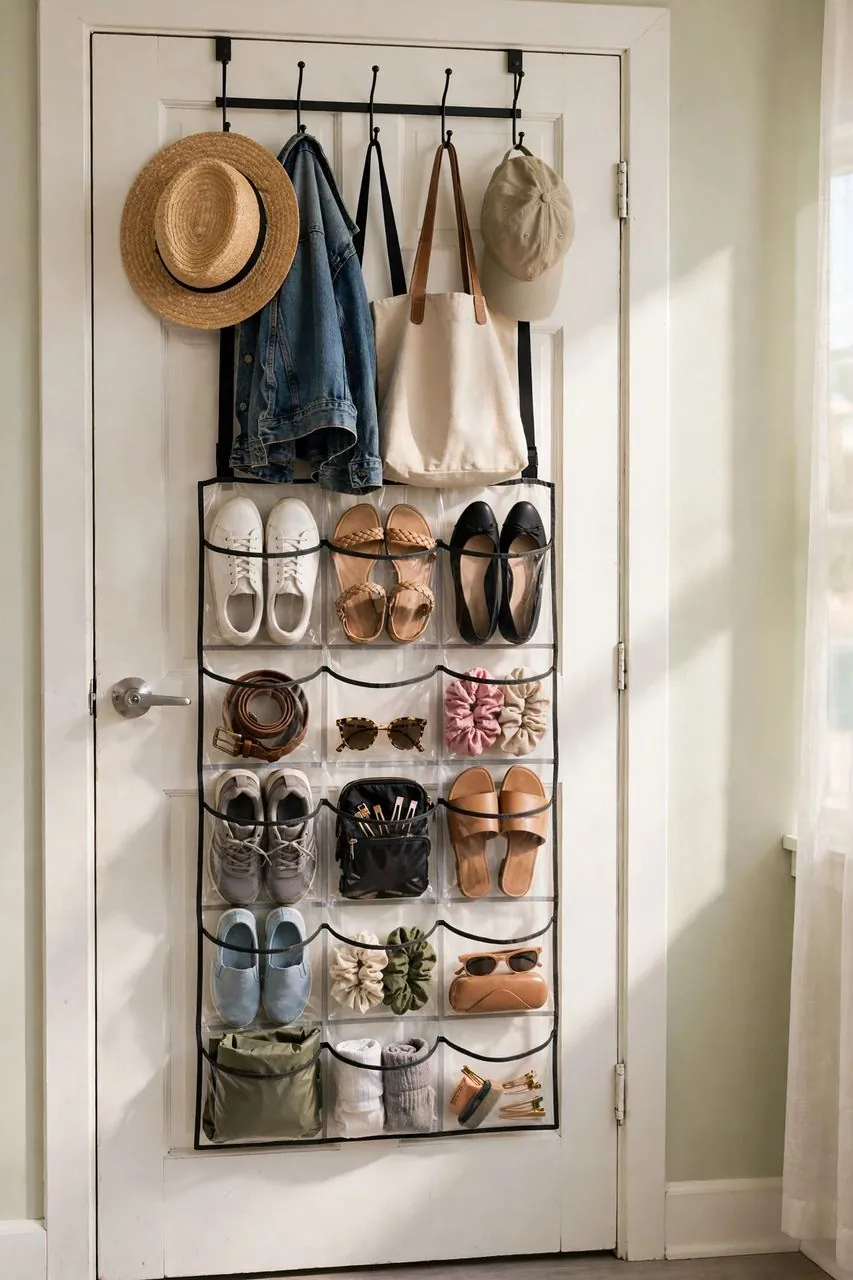
The best over the door organizer for most renters is a clear-pocket organizer on thin, padded hooks, fitted to a standard interior door with a healthy top gap. Measure your door thickness and top clearance first. If the door barely closes now, or it is hollow and already flexes, choose a wire rack for one strong door instead of loading a weak one.
In a hurry? Start with the first pick in the table below — it is the one most renters should look at first. Check Price on Amazon
Every rental has the same hidden storage unit, and it is already installed. It is the back of your doors. A bathroom door, a bedroom door, a pantry door, a closet door. Each one is a tall, flat, completely unused wall that swings. The trouble is that doors are not walls, and the organizers sold for them are not all honest about that. Buy the wrong one and you get the full symphony. A door that will not latch. A hook that chews the paint off the top edge. A loaded rack that bangs against the panel every time someone walks past, at volumes that feel personal at 6 a.m.
We wrote this guide around the failures, because the failures are where the real buying advice lives. We compared the formats renters actually buy, read the published specs and what owners report months later, and focused on the questions most roundups skip entirely. Will it fit a thick door. Will the door still close. What does the weight do to the hinges over a year. Which doors should never carry weight at all. If you measure two things before you order, the thickness of your door and the gap at the top, you will avoid almost every return in this category.
Our top pick for most homes is the humble clear-pocket organizer, fitted properly and loaded sensibly. See the top pick on Amazon
For the full map of door, wall, and corner storage, browse our No-Drill Storage hub before you buy anything.
Quick answer: the organizers at a glance
| Pick | Best for | Type | Key constraint | The catch |
|---|---|---|---|---|
| Clear-pocket organizer | See-it-all storage for bathrooms, nurseries, and small stuff everywhere | Clear pockets on a fabric panel with over-door hooks | Needs a standard door with enough top gap for the hooks | Pockets stretch and sag if you stuff them, and the clear panels scuff cloudy over time |
| Fabric tier organizer with rigid inserts | Bedrooms and nurseries with mixed bulky items | Deep fabric tiers stiffened by boards, on wider hooks | Needs a taller, sturdier door and the most top clearance of any pick | The heaviest empty organizer here, and all that structure still swings if the door is slammed |
| Wire basket pantry rack | Kitchens, pantries, and laundry doors with cans and jars | Metal frame with removable baskets | Needs a solid, well-hung door that can carry real weight | Concentrates serious load on two or three hooks and the top hinge, and small items fall through the wires |
| Deep-pocket shoe organizer | Shoes, boots, and bulky soft goods in bedrooms and closets | Oversized fabric pockets, often in a two-pack | Needs door width and a closet or bedroom door that opens fully | Wide shoes and heels fight the pocket shape, and a full one makes a light door feel heavy |
| Over-door hook rail | Coats, towels, bags, and daily grab-and-go items | Metal rail with a row of hooks over the door top | Only stores what hangs, and hooks must clear the frame | Point loads on hooks can dent soft door tops, and wet towels make it heavier than you planned |
| Slim organizer for narrow and shallow doors | Small bathrooms, linen closets, and tight hall doors | Narrow low-profile panel or single-column rack | Trades capacity for fit on doors the big organizers cannot use | You will outgrow it, because slim means a handful of items per tier at most |
Who this is for
This guide is for you if you rent, your closets are full, your bathroom has no cabinet, and your pantry is one shelf pretending to be a system. It is for you if you want storage today, with no tools, that lifts off the door the morning you move out and leaves nothing behind but a dust line. It is for parents turning a nursery door into nappy and wipe headquarters, for cooks whose spice collection has colonised the worktop, and for anyone whose shoes live in a pile that accuses them daily. If you can measure a door and be honest about weight, you can get this right the first time.
Who should skip over-the-door storage
Skip it, honestly, if every door in your home is a featherweight hollow-core door that already rattles in its frame, if your doors close so tightly that a sheet of paper barely fits the top gap, or if your lease specifically bans over-door hooks, which some do. Skip heavy racks entirely if your hinges already sag, if a door has dropped so it scrapes the floor, or if the door is glass-panelled, a bifold, or a sliding pocket door. Those doors are telling you something. Listen, and put the storage on a shelf instead. Our guide to the best no drill shelves covers the wall and corner options that ask nothing of your doors.
Best for most renters: Clear-pocket over-door organizers
There is a reason this format is the default, and it is not marketing. A panel of clear pockets turns the back of a door into a visible inventory. You see the spare toothpaste, the hair ties, the plasters, the baby wipes, the charging cable, without opening a single drawer. For bathrooms with no cabinet and nurseries with no spare surface, that visibility is the whole game. It earns the top slot because it solves the widest range of renter storage problems at the lightest load, and a light load is exactly what most rental doors should be carrying.
How it works is disarmingly simple. Two or three flat hooks slip over the top of the door, the panel hangs from them, and gravity does the rest. The better versions add small stabilisers or pads at the bottom corners to calm the swing. Look for pockets that are gusseted rather than flat-stitched, because a gusset is the difference between a pocket that swallows a bottle and one that merely leans against it.
Fit rules start at the top of the door, where every over-door product lives or dies. Measure the door thickness across the edge and compare it with the hook range stated on the pack, choosing a hook with a little room rather than one at its exact limit. Then check the top gap. Close the door and look at the space between the door top and the frame. The hook has to pass through that gap every time the door closes, so a door that already kisses its frame will not tolerate any hook, however thin the listing claims it is. Raised panels and decorative moulding near the top edge can also stop a panel sitting flat, so check where the hooks land, not just the door's edge thickness.
The honest downside is pocket discipline. Clear pockets stretch. Stuff each one to its limit and within months you own a row of hammocks, each holding its contents at a sad tilt and spilling when the door moves. Load pockets to comfortable, not maximum, keep the heaviest items in the bottom row where the panel is most stable, and accept that this format is for many small things, not a few heavy ones. The clear panels also scuff and cloud with use, so the crisp shop look fades. We consider that a fair trade for storage this useful, but you should know it going in.
Who should skip this one: anyone storing cans, jars, tools, or books, anyone with a door that barely closes, and anyone who hates a visual inventory staring at them. A closed fabric tier or a wire rack hides its contents better.
Best for bedrooms and nurseries: Fabric tier organizers with rigid inserts
When the things you need to store are bulky and soft, towels, nappies, spare clothes, soft toys, rolled blankets, deep fabric tiers beat pockets. The versions we rate add rigid boards in the base of each tier and stiffened side panels, so the tier holds a shape instead of collapsing into a fabric sigh. On a nursery door this becomes a changing station that never touches the floor. On a bedroom door in a flat with one wardrobe, it becomes the overflow wardrobe that keeps the chair-drobe at bay.
How it works is hooks at the top, a hanging frame, and tiers that slot or Velcro into place with their boards inserted. The boards are not a detail. Leave one out, or seat one crooked, and that tier sags, tips its contents forward, and swings harder than the rest. Assembly takes a few quiet minutes, and doing it carefully once is the whole secret of this format behaving for years.
Fit rules are stricter here, because structure adds weight and depth. The empty organizer is the heaviest on this page, before you store a single thing, so it belongs on a solid-feeling door with healthy hinges, hung on the room side where you can see it sit flat. Depth matters too. A deep tier on the back of a door that opens against a wall will meet that wall every time, so measure how far your door actually opens. Doors that open a full swing against nothing are ideal. Doors in tight hallways that stop early are not.
The honest downside is swing and presence. A loaded tier organizer is a piece of furniture hanging on a moving object. Open the door briskly and it travels. Good stabiliser pads at the bottom corners tame most of it, and loading heavy tiers low tames the rest, but a household of door-slammers will always know it is there. It is also the most visible pick here, a tall upholstered presence on your door, so pick a colour you can live with, because you will look at it daily.
Who should skip this one: anyone with a light hollow door, a door that opens against a wall or wardrobe, or a home where doors get slammed by wind, children, or both. Our renter-friendly bathroom storage guide has slimmer answers for tight bathrooms.
Best for pantries and kitchens: Wire basket over-door racks
Cans and jars break fabric organizers, slowly and then suddenly. For a pantry or kitchen door, a metal frame with baskets is the honest format. The baskets hold a shape under concentrated weight, you can reposition them to fit tall bottles and squat tins on the same door, and spills wipe off metal in a way they never wipe off fabric. In a rental kitchen with one cupboard, a rack like this on the pantry or kitchen door can hold the entire dry-goods overflow, and our kitchen hub and renter-friendly kitchen organization guide build the rest of the system around it.
How it works is a frame that hooks over the door and hangs in sections, with baskets clipping on at heights you choose. The load path is the thing to respect. Every tin you add travels through the baskets, up the frame, and into two or three hooks resting on the top edge of your door, and from there into the hinges. That is a legitimate way to store food, but it means this pick, more than any other, demands a door that deserves the job.
Fit rules are therefore about the door's health as much as its size. Choose a solid-core or at least a firmly hung hollow door that does not flex when you push its centre, with hinges that show no sag and screws that sit tight. Check the stated hook range on the pack against your door thickness, and confirm the door still latches with the hooks on before you clip a single basket. Distribute weight like you mean it, heaviest baskets at the bottom, nothing heavy at head height, and leave the top basket for light packets. If the door starts to feel different when it swings, heavier, slower, reluctant to latch, that is information. Unload a basket and listen to it.
The honest downside is that wire is unforgiving in small ways. Small packets slip through the gaps, round jars can rattle against metal on every door swing, and the frame's own weight counts against your total from the start. Basket liners, a folded tea towel under the jar row, and stabiliser pads solve most of the noise, but they are extra steps the fabric picks do not ask of you.
Who should skip this one: anyone with a flexing hollow door, sagging hinges, a glass-panelled kitchen door, or a household that cannot resist filling every basket to the brim. This format rewards restraint and punishes enthusiasm.
Best for shoes and bulky soft goods: Deep-pocket shoe organizers
The shoe organizer is the gateway product of this whole category, and the deep-pocket versions deserve their good name. Oversized pockets take a full pair in each, or boots folded at the ankle, or the trainers, caps, scarves, and gloves that otherwise colonise the hallway floor. They often arrive as two-packs, which quietly solves two doors at once, one for shoes and one for everything the entrance of a small apartment needs to swallow.
How it works is the same hook-and-panel system as our top pick, scaled up. The pockets are wider and deeper, usually with mesh or clear fronts so pairs are visible, and the panel is broader to match. That breadth is a fit question in itself. A wide panel on a narrow closet door will overhang the edges and catch on the frame, so measure door width as carefully as thickness with this pick.
Fit rules favour closet and bedroom doors that open fully and sit flat. Heels are the awkward tenant here, because a stiletto heel finds every seam and mesh panel it can, so lined or fabric-front pockets treat heels kinder than open mesh. Mud is the other reality check. This is a home for indoor and dry outdoor shoes, not a drip tray for wet boots, unless you add a washable liner and accept the cleaning rota that comes with it.
The honest downside is total weight in disguise. One pair of shoes is nothing. A full panel of pairs is a serious, swinging load that a light door will announce every time it moves, and the bottom pockets collect dust and grit that falls from every pair above them. Put the heaviest pairs at the top near the hooks, counterintuitive as that sounds for a panel, because the load hangs from the top and low heavy pockets swing the most. Actually, let us correct ourselves plainly, because this is where owners go wrong. Keep heavy pairs spread across the upper and middle rows, keep the bottom row for light pairs and accessories, and never load the bottom heaviest. A bottom-heavy panel is a pendulum.
Who should skip this one: anyone whose shoe problem is really a boot problem in a wet climate, anyone with narrow doors, and anyone whose bedroom door opens against the wardrobe, where a loaded panel will thump it forever.
Best for daily grab-and-go: Over-door hook rails
Not everything stores in a pocket. Coats, towels, dressing gowns, bags, and the dog lead all want a hook, and a hook rail over the door gives a whole row of them without a single fixing. On a bathroom door it replaces the towel bar your landlord never installed. On a bedroom door it ends the coat-on-the-bed era. It is the simplest product on this page and, used for hanging things only, one of the most reliable.
How it works is a flat metal bar that hooks over the door top and presents a row of single or double hooks. Double hooks, a large hook with a smaller one beneath, genuinely double the usefulness for households, one for the gown and one for the towel. The bar should sit dead flat against the door face, because a bar that rocks on its hooks will work its paint contact points like a slow file.
Fit rules centre on clearance and contact. The hooks over the top face the same top-gap test as every pick here, and the row of hooks needs the door to open without the loaded coats jamming against the wall or frame behind. Contact padding matters more on rails than panels, because the load hangs from distinct points. Look for rails with padded or coated contact faces, and add your own felt pads where metal meets paint if the maker skimped. Wet towels deserve a mention too. A rail of soaked bath towels is far heavier than the same rail dry, so space towels out and let the bathroom door carry people-sized loads only sometimes, not daily at maximum.
The honest downside is that a rail stores only what hangs, and what hangs takes visual space. A loaded rail reads as clutter to some eyes in a way a closed pocket panel does not. Hooks can also mark soft door tops under point loads over time, which is why the padding conversation above is not optional in a rental you care about.
Who should skip this one: anyone needing hidden or sorted storage for small items, anyone with a very tight top gap, and anyone planning to hang truly heavy bags daily. Hooks invite overloading because each one looks so willing. Resist.
Best for tight doors: Slim low-profile organizers
Some doors reject every standard organizer. The narrow linen closet door. The shallow bathroom door in an old building. The hall door with barely a whisper of top gap. For those doors, slim single-column organizers and narrow low-profile panels exist, and they are the difference between some storage and none. A single column of pockets down a narrow door still holds the medicines, the cleaning sprays under the sink door, or the socks and belts a small closet cannot.
How it works is subtraction. Fewer pockets, a narrower panel, thinner hooks, and sometimes a single hook instead of a pair, trading stability for fit. The better slim designs compensate with bottom stabilisers, because a narrow panel swings more readily than a wide one. If a slim organizer offers no stabiliser at all, plan to add adhesive-free pads or a simple door bumper yourself, as the methods section below explains.
Fit rules are the whole product here, so measure with unusual care. Door width, door thickness, top gap, and the swing clearance behind the door all get a number before you order. Slim organizers suit cupboard and closet doors especially well, and those doors hide a trap. Cabinet-style doors and thin closet doors flex more than room doors, so keep loads feather-light and spread across the panel, and never hang a slim organizer on a bifold door, because the folding action and a hanging panel are enemies from the first day.
The honest downside is capacity, obviously and always. You will fill it in a week and wish it were bigger, and that feeling is the product working as designed. It is a starter tier of storage for a door nothing else fits. Treat it as the place for the ten small things that currently have no home, not as a system, and it will delight you. Ask it to be a system and it will disappoint you on schedule.
Who should skip this one: anyone with a standard door that fits a full organizer, because you are paying in capacity for a fit you do not need, and anyone hoping to store bottles in bulk. Slim is for small and light, forever.
How to choose: measure the door before you fall in love
Most over-door disappointment is measurement disappointment wearing a costume. The organizer was fine. The door was never going to accept it. Two minutes with a tape measure, before you order, replaces a return, a refund wait, and a week of hallway piles. Here is the exact routine we recommend, in order.
Measure thickness, then measure the top gap
Open the door and measure straight across its edge, from one flat face to the other, not over any raised panel or bevel. Write the number down. Then close the door and study the gap between the top of the door and the frame. You can test it gently with a thin card or a folded sheet of paper at a few points along the top. If the card drags hard or will not pass, your top gap is too tight for most hooks, and slim thin-hook models or a different storage plan are your honest options. Compare your thickness number with the hook range stated on the pack, and choose a model with margin above your number. A hook at its absolute limit sits crooked, and a crooked hook is where paint damage and rattling both begin.
Judge the door itself: solid, hollow, and tired doors
Knock on the door. A solid-core door answers with a dull, dense thud and feels heavy to swing. A hollow-core door sounds like a drum and flexes a little when you press its centre. Hollow doors are not banned from this category, but they set the budget. Light pocket organizers and hook rails with modest loads, yes. Loaded wire pantry racks, no, because the weight concentrates at the top edge and the door skin and its hinges were never built for a pantry. Now look at the hinges. Open the door halfway and lift gently at the handle edge. Play or movement at the top hinge means the door is already tired, and adding a hanging load will hurry it along. Tighten hinge screws into the frame first, which is ordinary maintenance most landlords welcome, and if the door still sags or scrapes, retire it from storage duty entirely.
Which doors should never carry weight
Some doors should stay unemployed no matter how tempting the space looks. Glass-panelled doors concentrate stress at the frame around the glass. Bifold doors fold, and anything hanging joins the folding whether it wants to or not. Sliding and pocket doors have no top edge to offer and tracks that resent interference. Fire doors in apartment buildings should never be loaded or propped or fitted with anything that affects how they close, full stop, because that door has a life-safety job. Exterior doors deserve caution too, since hooks can break the weather seal at the top and invite drafts and water. And any door that already fails to latch cleanly is disqualified until it is repaired. An organizer that stops a door latching has not added storage. It has subtracted a door.
Distribute weight like the hinges are watching, because they are
Every gram on the panel hangs, ultimately, from the top of the door and the top hinge. So load with the swing in mind. Heavy items go low on fabric tiers where the structure supports them, but spread across the width rather than stacked in one column, and on pocket panels the heaviest small items belong in the lower rows near the stabilisers. On wire racks, the bottom baskets take the tins and the top basket takes the crisps, never the reverse, because a falling tin from head height is a story you do not want. Keep the total honest. Check the stated total rating on the pack, then load to a comfortable share of it, and re-check after a week, because the natural history of every organizer is slow, cheerful overfilling.
Protect the finish and silence the swing
Paint protection is a five-minute job that saves a deposit argument. Add felt or foam pads wherever metal touches the door, at the hook faces over the top edge, at the back of the frame, and at the bottom corners where panels kiss the door. Many organizers include pads, and the ones that do not are telling you to supply your own. For noise, the same bottom pads do double duty as bumpers. A strip of self-adhesive felt along the back of a wire frame quiets the rattle against the panel, and tightening the fit so the organizer cannot build up swinging momentum quiets the rest. A door that announces its organizer is a door whose organizer fits badly. Fix the fit and the concert ends.
Mistakes and red flags: what not to buy and what not to do
The one-star reviews in this category read like a family saga, and the same relatives keep appearing. The door that would not close. The hooks that ate the paint. The rack that taught the hinges to sing. Almost every one was avoidable at the measuring stage, which is why we keep returning you there like a chorus.
Red flag one is a listing that never states a door thickness range. A maker who will not tell you what door the hooks fit is asking you to gamble with your door, and the house usually wins. Red flag two is a huge total load claim paired with two thin unpadded hooks, because arithmetic and leverage both object, and the top edge of your door will be where the objection lands. Red flag three is a wire rack with no stabilisers and no pads included, sold for pantry use, because a loaded swinging rack of tins against a hollow door is a percussion instrument with a grudge. Red flag four is pockets with no gusset and seams you can see straining in the product photos themselves. If it sags empty in the listing, imagine it full in February.
The usage mistakes matter as much as the buying ones. Hanging the organizer before checking the latch, then forcing the door closed for weeks, slowly bends hooks and shaves paint in a way nobody notices until move-out. Loading one side heavy because that is where the tall bottles fit turns a panel into a pendulum. Putting the organizer on the bathroom door and then storing heavy glass bottles in the top pockets combines height, weight, and hard floors into the worst possible fall. And the quiet classic, using the organizer as a doorstop, wedge, or coat mountain beyond any rating, works right up until the day the top hinge screws begin to pull, which announces itself as a door that suddenly will not close at all.
One more mistake deserves its own sentence because landlords mention it in inspections. Hooks left on a door for years can leave a polished wear line and compressed paint on the top edge even when they were padded. Lift the organizer off every few months, wipe the top edge, check the pads are still soft, and replace pads that have flattened. Two minutes, twice a year, and the door looks untouched at the end of a long tenancy. Pair that habit with the shelf strategies in our no-drill shelves guide and no wall or door in your home needs to fear inspection day.
Removal and your deposit: taking it down without a trace
Here is the beautiful truth about this whole category. Removal is where over-door storage beats every wall system ever made. Our deposit protection hub covers the full move-out method, and the door chapter is short enough to learn by heart. Empty it, lift it, wipe it, done. But the details still matter, because almost is not a deposit strategy.
Start by emptying the organizer completely before you lift anything, because a half-loaded panel swings, twists its hooks, and can rake the door face on its way off. Support the panel or frame with one hand, lift the hooks straight up and clear of the top edge with the other, and carry it away from the door rather than letting it slide down the face. On wire racks, unclip the baskets first and lift the frame in sections, because a full frame is exactly the size and weight to ding a door edge or a wall corner on its journey out of the room.
Then inspect the three places this category can leave evidence. The top edge, where hooks sat, may show a wear line or compressed paint. A gentle wipe with a damp cloth handles dust lines, and a faint shine difference usually fades once the door is uniformly clean. The door face, where panels and frames rested, can hold a dust outline that makes the rest of the door look dirtier than it is, so wipe the whole face, not just the outline, for an even finish. The frame head, above the door, occasionally shows a scuff where tall hooks kissed it on closing. That touches up with a dab of matching paint on a cotton bud, feathered out, exactly as with a shelf mark.
Check the door's behaviour as your final inspection. It should swing, latch, and sit in its frame exactly as it did before the organizer arrived. If it has begun to drag or the top hinge screws have loosened under a long heavy load, tightening the hinge screws into the frame is a legitimate, landlord-friendly fix that restores the door in minutes. Photograph each door top edge and face after removal, just as you photographed your walls. In a deposit conversation, the renter with dated photos and clean doors is not arguing. They are presenting.
Frequently asked questions
- Will an over the door organizer stop my door from closing properly?
- It can, if the hooks are too thick for the gap between the door top and the frame. Before ordering, close the door and test the top gap with a thin card. Choose hooks with a stated range that covers your door thickness with a little room to spare. If the door already kisses its frame or struggles to latch today, skip over-door storage on that door entirely.
- How do I measure my door for an over the door organizer?
- Measure straight across the edge of the open door from one flat face to the other, avoiding raised panels and bevels. Note the width of the door too, especially for wide shoe organizers. Then check the top gap with the door closed, using a thin card at several points. Compare your numbers with the hook range and panel size stated on the pack before you buy anything.
- Can a hollow core door hold an over the door organizer safely?
- A hollow door can hold a light organizer, such as a clear-pocket panel or a modest hook rail, loaded gently and spread across its width. It should not carry a wire pantry rack full of cans and jars, because that weight concentrates at the top edge and strains the hinges. Press the centre of the door. If it flexes easily or sounds like a drum, keep the load feather-light or choose another door.
- Will over the door hooks scratch or dent my door?
- Unpadded metal hooks can wear the paint on the top edge over time, especially under heavy loads and daily swinging. Choose hooks with padding or a coated finish, and add felt or foam pads at every contact point, including the bottom corners of the panel. Lift the organizer off every few months, wipe the top edge, and replace pads that have gone flat. That small habit keeps doors looking untouched for years.
- How do I stop my over the door organizer banging and rattling?
- Rattling means movement, and movement means a loose fit somewhere. Add the stabiliser pads at the bottom corners so the panel rests against the door instead of swinging free. Put felt strips along the back of a wire frame, spread the load evenly so nothing acts as a pendulum, and check the hooks sit flat and snug on the top edge. A well fitted organizer is a quiet one.
- How much weight can I honestly put on an over the door organizer?
- Treat the total rating on the pack as a best case for a strong door with the load spread perfectly, not as your target. Weigh or honestly estimate what you plan to store, keep to a comfortable share of the stated total, and put heavy items low and spread across the width. If the door starts to swing differently or latch reluctantly, it is over its honest limit, whatever the box said.
- Can I use an over the door organizer on a thick door?
- Yes, with the right hooks. Standard hooks suit standard interior doors, and thicker solid doors need hooks with a wider stated range, which some ranges offer specifically. Measure your door edge first and match the hook range to it with margin to spare. Never force a tight hook over a thick door, because it will sit crooked, mark the top edge, and often stop the door latching at all.
- Are over the door organizers safe for pantry cans and jars?
- They are, on the right door and in the right format. Choose a metal basket rack rather than fabric pockets, hang it on a solid and well-hung door, put the heaviest baskets at the bottom, and keep glass jars out of the top rows. Check the stated rating on the pack, load well within it, and recheck the hinges after the first week. A flexing hollow door and a full rack of cans do not belong together.
- Which doors should I never hang an organizer on?
- Never load glass-panelled doors, bifold doors, sliding or pocket doors, or exterior doors where hooks can break the weather seal. Apartment fire doors must never carry anything that affects how they close. Add any door that already sags, scrapes, flexes in the middle, or fails to latch cleanly. Those doors need repair or rest, not a new job carrying your storage around all day.
- Can I put an over the door organizer on a bathroom door?
- Yes, and the bathroom door is often the best door in the home for one. Choose clear pockets or coated metal that shrugs off steam, avoid plain fabric that stays damp, and keep heavy glass bottles low or off the panel entirely. Our bathroom hub covers the rest of the small bathroom system. Check the top gap as always, because bathroom doors in older homes often close tighter than you expect.
- Will an over the door organizer damage my hinges over time?
- A light organizer on a healthy door will not trouble sound hinges. A heavy rack on a door whose hinges already sag is a different story, because the extra load hangs from the top hinge all day. Check for play at the top hinge before you hang anything, tighten loose hinge screws into the frame, spread loads sensibly, and unload a door that starts to swing or latch differently. Doors tell you early. Listen early.
- What is the best over the door organizer for a nursery?
- A fabric tier organizer with rigid inserts usually wins in a nursery, because deep tiers swallow nappies, wipes, changes of clothes, and soft toys, and everything sits visible at changing height. Hang it on a sturdy door, load heavy tiers low, and use the stabilisers so it never swings near the changing area. Keep tiny items that could be mouthed in closed containers on a high tier, well out of reach as your baby grows.
- Can I use an over the door organizer on a closet door?
- Usually yes, and closet doors are prime territory, especially for shoe organizers and accessory panels. Measure the door width, because closet doors are often narrower and wide panels can overhang and catch the frame. Thin closet doors flex more than room doors, so keep the load light and spread out. Never hang anything on a bifold closet door, because the folding action will fight the panel from the first day.
- How do I keep a shoe organizer from making the door feel too heavy?
- Spread pairs across the upper and middle rows rather than loading the bottom, which turns the panel into a pendulum, and keep the bottom row for light pairs and accessories. Do not fill every pocket just because it exists. If the door still feels heavy, move half the pairs to a second door or a floor rack. Shoes add up quietly, and a door should always swing like a door, not like luggage.
- Do over the door organizers work on doors with raised panels or moulding?
- They can, with care. The hooks care about the top edge, so check the hooks land on a flat part of the edge and the stated range still matches. The panel cares about the face, and raised moulding near the top can push the panel outward so it hangs at an angle and swings more. Test the fit with the door fully closed and fully open before loading, and add pads where the panel meets the moulding.
- Can my landlord object to over the door organizers?
- Some leases ban over-door hooks by name, and some landlords simply dislike anything that might mark a door, so read your lease first. Where they are allowed, padded hooks, sensible loads, and doors photographed before and after make a calm case. If your landlord says no, respect it and move the storage to a wall or floor system instead. The relationship is worth more than any single organizer, and other options always exist.
- How do I clean an over the door organizer properly?
- Empty it fully first, because cleaning a loaded organizer just moves the dust around. Fabric and clear-pocket panels usually wipe down with a damp cloth, and clear pockets benefit from a gentle wash to restore visibility. Wire racks can be taken down in sections and washed at a sink. Let everything dry completely before reloading, especially fabric heading back into a steamy bathroom, and use the empty moment to check hooks, pads, and seams for wear.
- What should I do if my door starts scraping the floor after adding an organizer?
- Unload the organizer first, because new weight on tired hinges is the most likely cause and the fastest one to test. Check the top hinge screws and tighten them into the frame, which lifts many sagging doors back into line. If the door still scrapes with nothing hanging on it, the problem predates your organizer and belongs in a polite maintenance request to your landlord, with your organizer staying off that door meanwhile.