Home › Bathroom › Best No-Drill Shower Caddy
Best No-Drill Shower Caddies: Adhesive vs Tension vs Hanging
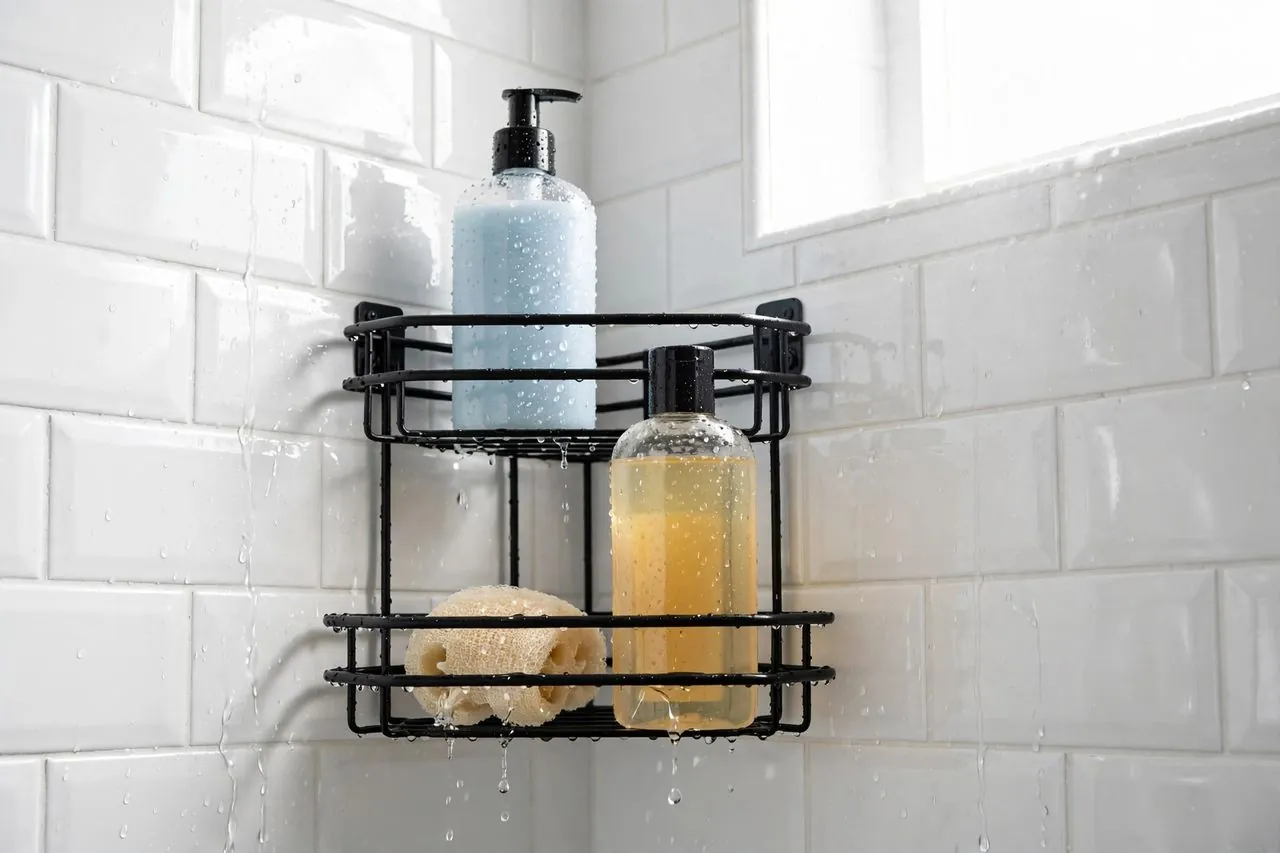
The best no drill shower caddy for most renters is an adhesive corner shelf on smooth tile or glass, installed on a cleaned, alcohol-wiped surface and left to cure before loading. Choose a tension pole if your walls are textured, and a hanging caddy if you need storage today with zero cure time.
In a hurry? Start with the first pick in the table below — it is the one most renters should look at first. Check Price on Amazon
If you rent, you already know the shower storage problem by heart. Bottles line up along the tub edge, one falls every time you reach for the conditioner, and the one storage method that would actually solve it — screws into the tile — is the one thing your lease forbids. We have lived in that exact bathroom, more than once, and we wrote this guide the way we wish someone had written it for us: method first, product second.
Here is the honest truth most roundups skip. There is no single best no-drill caddy. There are four different ways to hold bottles up without a drill — adhesive pads, a tension pole, a hook over the showerhead, suction, plus two stand-alone workarounds — and each one is brilliant on the right shower and hopeless on the wrong one. The right question is not which caddy is best. It is which method matches your walls, your ceiling, your shower door, and your bottles. Get the method right and almost any well-made pick in that family will serve you well. Get it wrong and even the most loved product on the internet will be on the floor by Friday.
Our number one pick for the most common rental shower — smooth tile or glass, a normal corner, a handful of daily bottles — is a two-pack of adhesive corner shelves in rust-resistant stainless steel, because corners waste the least space and two smaller shelves beat one overloaded one. Start there if your walls are smooth:
A quick word on how we chose, because it matters for how much you should trust us. We did not invent test results, and we will not pretend we ran a laboratory. Our picks come from published manufacturer specifications, large volumes of owner reports, and clear reasoning about how each mounting method actually behaves in steam. Where a pack states a load rating, we will tell you to match that stated rating to the real weight of your bottles — we will never dress a marketing number up as our own measurement. You can read more on our How we review page, and you will find the rest of our renter-first bathroom guides in the Bathroom hub.
The decision table: six ways to store bottles without a drill
| Pick | Best for | Type | Key constraint | The catch |
|---|---|---|---|---|
| Adhesive corner shelves, 2-pack | Most renters with smooth tile or glass | Adhesive | Needs a flat, smooth area that avoids grout lines, plus a full cure before loading | Our top pick still fails on textured tile, and the pads are single-use if you place one badly |
| Corner tension pole caddy, 4-tier | Textured walls, heavy bottles, big households | Tension pole | Needs a solid, flat ceiling and a tub ledge or floor the pole can brace against | Takes the longest to assemble, and a sloped or soft ceiling can defeat it completely |
| Adjustable hanging caddy over the showerhead | Storage today, with no cure time and no wall contact | Hanging | Needs a standard shower arm and clearance below the showerhead | Cheap versions swing and slide; handheld hoses can tangle in the frame |
| Locking suction shelf | Light daily essentials on glass or glossy tile, and anyone who moves often | Suction | Needs a perfectly smooth, non-porous patch with no grout line under the cup | The weakest hold of the group; treat it as a light-duty shelf, never a family bottle store |
| Over-door shower caddy | Framed glass shower doors and stalls with no usable wall | Over-door | Door must be within the hook width the maker states, and must still close cleanly | Can rattle, can rub the door frame, and does not suit frameless or sliding doors |
| Freestanding corner stand | Awkward walls, no ceiling for a pole, and zero appetite for adhesives | Freestanding | Needs a corner of floor or tub deck you can genuinely spare | Eats floor space in small stalls and can tip if a tall bottle makes it top-heavy |
Read the constraint column before you fall in love with any row. In our experience, nearly every disappointed no-drill buyer we hear from bought a perfectly decent product whose one key constraint their bathroom could not meet. The caddy was fine. The match was not.
Who this guide is for
This guide is for you if you rent and your lease bans drilling, if you have just moved and the tub edge is already a bottle traffic jam, or if a previous caddy rusted, slipped, or took a dive at 2 a.m. and you want to understand why before you spend again. It is also for you if you share a shower, because shared showers are where the method differences really show: one person needs two shelves, two people need a system. If your bathroom is part of a wider rental reset, pair this guide with our renter-friendly bathroom storage ideas so the shower, sink, and door all work together instead of competing for the same four products.
Who should skip no-drill entirely
Skip this whole category, kindly, if you own your home and plan to stay for years. A properly anchored, screwed-in shelf will out-hold every method on this page, and pretending otherwise would be dishonest. Also skip adhesive and suction if your shower walls are heavily textured, painted, or made of matte stone and you are not willing to switch to a pole, hanging, or freestanding option — no pad we can recommend will rescue a surface it was never designed for. And if your landlord has banned even removable adhesives in writing, respect that clause and choose a hanging or freestanding caddy instead; your deposit is worth more than any shelf. Our deposit protection hub explains how we think about that trade-off across the whole apartment.
How the four mounting methods actually compare
Before the picks, the comparison that should drive your decision. Adhesive mounting spreads the load across a flat pad bonded to the wall itself. Done on the right surface with the right prep, it is the strongest and neatest no-drill option, it places shelves exactly at your reach height, and it leaves the shower floor completely clear. Its weakness is total dependence on the surface: smooth and non-porous is a yes, textured or painted is a slow-motion no. It also asks something of you — patience. The bond needs its full cure time before bottles go on, and renters in a hurry are the number one cause of adhesive failure stories.
Tension poles ignore your walls entirely and borrow their strength from the floor-to-ceiling squeeze. That makes them the answer for textured tile, painted surrounds, and matte stone, and the four-tier format holds more than any other method here. The price is setup effort, a real dependence on a solid flat ceiling, and a footprint in the corner of your shower. Sloped ceilings, ceiling panels that flex, and some fiberglass surrounds with curved corners can all rule a pole out, so measure and look up before you order.
Hanging caddies borrow the shower arm instead. They install in a minute, need no cure, move with you from rental to rental, and never touch a wall — which is why they remain the safest choice when a lease is strict or a stay is short. Their weaknesses are movement and fit. A hanging caddy lives on a pipe that was never designed as furniture, so stability features — a clamping hook, stabilizer suction cups at the base, an anti-swing shape — matter more than shelf size. Handheld shower hoses add a second problem, because the hose wants to hang exactly where the caddy is; look for split designs that let the hose pass down the middle, or choose a different method.
Suction is the most honest method to describe: wonderful within its limits, disappointing outside them. A locking suction cup on clean glass or glossy tile holds light daily items beautifully and removes in seconds with zero residue, which makes it perfect for short lets, guest bathrooms, and anyone who rearranges often. But suction is a seal, and seals hate texture, grout lines, steam-softened edges, and heavy loads. We include a suction pick below because for the right job it is genuinely the best tool — but we will keep repeating its limits, because overselling suction is how renters end up with a shelf in the tub.
Finally, the two workarounds. Over-door caddies move the storage problem to the shower door, which works well on framed glass doors and fails politely on everything else. Freestanding corner stands opt out of the mounting question altogether and simply stand there, which is sometimes the smartest answer of all — especially in odd bathrooms where the walls are textured, the ceiling slopes, and the shower arm is too short for a hanging caddy. If you are comparing wall options more broadly after this, our guide to the best no-drill shelves covers the same methods beyond the shower.
Best for most renters: Adhesive corner shelves, 2-pack in stainless steel
This is the pick we would hand to a friend moving into a typical rental this weekend, and it earns the top slot for a simple reason: it solves the most common version of the problem with the fewest compromises. A corner is the part of the shower you never stand in, so corner shelves return the tub edge and the floor to you without stealing elbow room. A two-pack matters more than it sounds. Two modest shelves, one for hair products and one for body products, stay tidier than one big basket, spread the load across two separate adhesive bonds instead of one, and let two people keep separate shelves in a shared shower.
Look for a set in stainless steel with an open wire or slatted base. The open base is not a style choice; it is the rust strategy. Water that drains through cannot pool, and pooled water is what turns a cheap caddy orange and slimy within a season. A raised guard rail around the basket keeps tall pump bottles from walking off the edge when you reach past them, and a couple of hooks underneath — for a razor and a loofah — will do more for daily tidiness than a third shelf ever will. Several well-reviewed sets from makers such as EUDELE, YASONIC, and Kitsure follow this pattern, which is exactly why the format, not a single brand name, is our recommendation: pick the version whose stated dimensions fit your corner and whose pack includes spare adhesive pads.
Surface rules for this pick are strict, and we will not soften them. The pads need smooth, non-porous tile, glass, polished marble, or metal. The whole pad must sit on one continuous surface — if a grout line runs under the pad, the bond is broken before you start, because the pad bridges a tiny valley instead of gripping a flat wall. Textured tile, tumbled stone, painted drywall, and wallpaper are all no. If your tiles are small, measure them: a pad that is wider than one tile will almost always cross grout, and that is the single most common reason corner shelves in small-tile showers let go.
The honest downsides: the adhesive pads are single-use, so a crooked first placement costs you a pad and possibly a spare-pad purchase. You also cannot use the shower properly for the full cure window the maker states — plan the install for a morning when you can shower elsewhere or the night before a day out. And like every adhesive product, this one will eventually meet a steamy, soap-filmed wall it cannot hold if you skip the monthly wipe-down we describe in the care section below.
Who should skip this one: anyone with textured, painted, or small mosaic tile where a pad cannot sit flat, and anyone who needs storage in the shower tonight rather than tomorrow.
Best for textured walls and heavy bottles: Corner tension pole caddy, 4-tier
If the adhesive pick is the answer for smooth walls, the tension pole is the answer for every wall adhesive cannot touch. Because the pole braces between the tub ledge or shower floor and the ceiling, the wall surface becomes irrelevant — textured tile, painted surrounds, matte stone, even a slightly uneven corner all stop mattering. That freedom is why this is also our pick for big households and serious product collections. Four tiers hold a family-sized rotation of bottles with room to spare, and the better designs let you slide each basket to the height your tallest pump bottle actually needs.
What to look for: a pole with a genuine spring or twist-lock mechanism that feels firm rather than spongy once installed, baskets in rust-resistant stainless steel or coated metal with open drainage, and rubber end caps that protect both the ceiling and the tub surface — those caps are also your deposit protection, so check they are included and intact. Measure your floor-to-ceiling or ledge-to-ceiling height carefully before ordering and compare it honestly with the height range the maker states. A pole bought for the wrong range is the tension equivalent of a pad stuck over grout: it was never going to hold, and it is not really the product that failed.
Surface rules here are about structure, not finish. You need a solid, flat ceiling that does not flex when you press it — some lightweight ceiling panels and drop tiles will bow under tension and slowly let the pole walk. You need a flat landing at the bottom too, ideally a wide tub ledge or a flat shower floor corner; narrow, curved tub edges give the pole a poor footing. Sloped ceilings are the hard no. If your bathroom ceiling slopes, skip to the freestanding pick below and save yourself a return.
The honest downsides: assembly takes longer than any other pick here — set aside a calm half hour, not five annoyed minutes before a shower. The pole and baskets also want a regular wipe, because a tall metal structure in a steamy corner collects soap film on every tier, and black finishes show that film fastest. Finally, a loaded four-tier pole is genuinely heavy to move, so choose its corner as if you mean it.
Who should skip this one: anyone with a sloped or flexible ceiling, a very small stall where the corner footprint costs too much standing room, or a short tenancy where the setup time is not worth it.
Best for instant storage with zero wall contact: Adjustable hanging caddy over the showerhead
The hanging caddy is the oldest no-drill method and still the fastest: hook it over the shower arm, and you have shelves before the water warms up. For strict leases, short stays, dorms, and anyone whose walls and ceiling have both ruled themselves out, this is often the only method left standing — and a good one is genuinely good. The word that matters in this category is adjustable. Fixed shelves were designed for the short bottles of twenty years ago. Modern pump bottles are tall, so look for shelves that slide up and down, a neck that extends for high shower arms, and, if you are short, a design that brings the lowest basket within your comfortable reach rather than the manufacturer's.
Stability is the whole game. The picks worth buying combine a hook that clamps or grips the shower arm — not one that simply rests on it — with suction stabilizers at the base that press against the wall and stop the swing. That base contact is light and removable, which keeps it renter-safe, but it does mean the stabilizers need the same smooth patch of wall suction always needs. If they land on a grout line, slide the caddy or accept a little movement. Rust-resistant stainless steel and anodized aluminium are the materials to look for here; plated finishes that chip at the hook will rust exactly where the water hits hardest.
If you have a handheld shower, read this paragraph twice. The hose hangs from the same arm the caddy hangs from, and on a one-piece caddy it will tangle, pull the caddy sideways, and annoy you daily. The fix is a split design with a gap down the middle for the hose, which several makers now offer — or a decision to use adhesive or a pole instead. There is no third option that ends well.
The honest downsides: even the best hanging caddy holds less than a pole and moves more than an adhesive shelf. It also puts your bottles directly under the showerhead, the wettest spot in the room, so drainage and a weekly rinse matter. And if your shower arm is very short, decorative, or oddly angled, some hooks simply will not sit level — check your arm shape against the product photos before you order.
Who should skip this one: anyone with a handheld hose and no split-design option, anyone who hates any movement in their shelves, and anyone whose shower arm is non-standard.
Best for light essentials and frequent movers: Locking suction shelf
We include suction with respect, as long as we are both honest about its job description. A locking suction shelf is a light-duty, fully reversible shelf for the things you reach for daily and nothing more: a razor, a bar of soap in its dish, one bottle of face wash, a small shampoo. Used that way — on glass or glossy tile, within the weight the maker states — it is the easiest storage in this entire guide. It goes up in under a minute, comes off in seconds with no residue and no heat and no tools, and can move to a new rental, a guest bathroom, or a different wall whenever you like. For short lets and indecisive arrangers, nothing else comes close.
The designs worth buying use a mechanical lock — a lever, dial, or push mechanism that evacuates air and shows you the cup is engaged — rather than a plain cup you just press and hope with. A removable basket that lifts off its suction mounts for cleaning is a second mark of a thoughtful design, because the cup-to-wall seal is happiest when you are not scrubbing around it every week. Position the shelf slightly out of the direct spray if you can; a seal that is not being hammered by the full shower stream lasts noticeably longer.
Surface rules are absolute. The cup needs a smooth, non-porous, completely flat patch — glass, glossy ceramic, polished stone — with no grout line, chip, or texture anywhere under the rim of the cup. Matte and textured finishes leak air microscopically, and a slow leak is a shelf that lets go at night three weeks later, which is why suction gets its unfair reputation: most failures are surface mismatches, not weak cups. Clean both the wall and the cup, dry both fully, and re-seat the cups every month or so as preventive care. Think of re-seating the way you think of shaking out a bath mat — thirty seconds of maintenance that stops a problem you would otherwise blame on the product.
The honest downsides are the reason this pick sits fourth and not first. Suction has the lowest real-world load tolerance of any method here, whatever the box claims, so family-size bottles are out. Steam and heat slowly soften seals, so a very hot, poorly ventilated bathroom shortens the interval between re-seats. And a falling suction shelf, while rare when loaded lightly, always falls at the worst moment — which is another argument for keeping glass bottles off it entirely.
Who should skip this one: anyone wanting to store multiple full bottles, anyone with textured or matte walls, and anyone who knows they will never re-seat a cup as maintenance.
Best for framed glass doors: Over-door shower caddy
Some showers simply have no wall to give you. The stall is all glass, the tiles are textured, the ceiling slopes — and the door is standing right there, flat, smooth, and unemployed. An over-door caddy hooks over the top of a framed glass shower door and hangs its baskets inside the shower, where the bottles belong. When the door suits it, this is a tidy, genuinely drill-free solution that touches nothing but the door itself, and it pairs naturally with the wider door-storage ideas in our guide to the best over-the-door organizers if your rental leans on doors everywhere.
Fit is everything, so measure before anything else. Note your door thickness and compare it with the hook width the maker states — too loose and the caddy swings and rattles with every door movement, too tight and it will not sit down over the frame at all. Look for hooks with a soft lining or padding on the contact points, because bare metal on a door frame, repeated daily, is how small scratches happen, and small scratches on a landlord's glass door are exactly what we are all here to avoid. Stabilizer pads or suction feet at the base of the caddy keep the lower end from swinging against the glass when the door opens; treat them as essential, not optional.
Surface rules translate here into door rules. Framed doors with a defined top rail suit this method best. Frameless glass can work with the right padded hooks, but sliding doors are the hard no — a caddy needs clearance to hang and a sliding door has none to give. Also walk through your own routine before ordering: if your door opens inward, check the caddy will not meet the showerhead or the wall at full swing, and if two people shower at very different heights, remember the baskets hang at door height, not at your height.
The honest downsides: capacity sits in the middle of the range — more than suction, less than a pole. The caddy moves a little every time the door moves, so pump bottles with a high centre of gravity can feel precarious on the top tier. And in hard-water areas the hooks and rails collect limescale at the contact points, which needs a wipe before it becomes a crust that holds the caddy slightly crooked.
Who should skip this one: anyone with sliding doors, very thick or very thin doors outside the stated hook range, or a door that already sticks or scrapes when it moves.
Best for impossible bathrooms: Freestanding corner stand
Every renter eventually meets the bathroom that defeats every mounting method: textured walls, a sloped ceiling, a stubby shower arm, a sliding door. The freestanding corner stand is our answer for that bathroom, and we mean it as a compliment. A good stand asks nothing of the room at all. It stands in the corner, holds two or three tiers of bottles on adjustable feet that level it on an uneven tub deck or shower floor, and leaves with you on moving day without a single mark to explain. In a tub-shower combination with a wide deck, it can be the most stable option on this entire page, because gravity is a more reliable landlord-pleaser than any adhesive.
Look for adjustable shelves, because bottle heights vary, and adjustable feet, because rental floors always slope a little more than you expect. Materials matter here in a specific way: a stand sits in pooled water at its base, so rust-resistant stainless steel or anodized aluminium earns its keep at the feet and the lowest tier first. Solid shelves with drainage slots beat fully solid trays, which become shallow ponds for soap scum, and a slightly weighted, wide-based design beats a narrow elegant one every time a tall conditioner bottle goes on the top tier.
Placement is this pick's surface rule. Put the stand in the corner opposite the shower entry, so you are not squeezing past it, and ideally in the corner that catches the least direct spray. In a very small stall, measure the footprint honestly against your standing room — a stand that costs you your footing is a bad trade no matter how many bottles it holds. If floor space truly does not exist, that is the pole or the hanging caddy's cue, and our small apartment hub has more on making tiny bathrooms work as a system.
The honest downsides: it uses the scarcest resource in a small shower, floor space. It can tip if loaded top-heavily by a careless hand, and bottles on its lowest tier live closest to the wettest, grimiest part of the shower, so that tier suits sturdy, sealed bottles rather than bar soap or anything in cardboard packaging. It is also the least built-in-looking option here — a guest will read it as furniture, not as part of the bathroom.
Who should skip this one: anyone in a compact stall where every inch of floor is standing room, and anyone who wants a fitted, minimal look above all else.
How to install each method properly
Most no-drill failures are installation failures wearing a disguise, so this section is the highest-value part of the guide. For adhesive shelves, the correct sequence is this. First, choose the position with your bottles in hand, standing in the dry shower, and mark it lightly in pencil — including a check that no grout line passes under either pad. Second, scrub that exact area with a bathroom cleaner to remove soap film, because soap film, not steam, is the invisible layer most pads are actually stuck to. Third, rinse, dry completely, then wipe with the alcohol pad from the pack or a little rubbing alcohol on a cloth, and let that flash dry. Fourth, apply the pads exactly as the maker directs, press firmly for the full time stated, and attach the shelf. Fifth — the step everyone skips — wait the full cure time stated on the pack before loading a single bottle. If the pack says wait, that wait is the product. A shelf loaded early may hold for a week and then fail, and you will blame the pad for a decision made on day one.
For a tension pole, assemble it outside the shower where you have room, then set the bottom foot in its corner and extend the pole until it meets the ceiling with firm resistance. Check it is vertical — a leaning pole loosens itself. Load the heaviest bottles on the lowest tier for the first day, and re-check the tension after a week, because new poles settle. For a hanging caddy, seat the clamp on the shower arm fully before hanging any shelf weight on it, then press the base stabilizers onto clean, dry wall — and if a stabilizer lands on grout, shift the caddy rather than forcing the seal. For suction, clean and dry both surfaces, engage the locking mechanism fully, and test with a gentle downward pull before trusting it with even a light bottle. For an over-door caddy, hang it empty first, open and close the door slowly through its full swing, and only then load it, lightest items on top. For a freestanding stand, level the feet, load the bottom tier first, and give it one deliberate nudge to confirm it sits solidly before it earns your glass bottles — actually, keep glass bottles off every method here. That rule has no exceptions we are comfortable printing.
Steam, soap film, and keeping any caddy alive
Steam does not attack a caddy all at once; it works through routine. Hot showers fill the room with moisture that condenses on every surface, softens adhesive edges over months, feeds the pink film that colonizes corners, and carries soap and shampoo residue onto shelves, where it dries into a slick layer that makes bottles slide and pads — on the wall behind — slowly lose their clean contact. You cannot stop steam, and you should not have to shower cold for your storage. What works is boring and effective: run the bathroom fan or crack the door after showering, wipe the shelves themselves every week or two so residue never becomes a permanent coating, and keep bottles wiped at the base, because a bottle sitting in its own soapy ring is quietly gluing itself to the shelf and stressing the mount every time you pull it free.
Ventilation deserves one more sentence because renters underestimate it. A shower that dries fully between uses is kind to adhesive, kind to suction seals, unkind to mould, and noticeably kinder to your deposit than a shower that stays damp all day. If your bathroom has no fan, a door left ajar after your shower does more for every pick in this guide than any upgrade we could sell you. More renter-proof routines like this live in our no-drill storage hub, which collects every method we trust across the apartment.
Mistakes and red flags: what not to buy
Walk away from any listing that promises a huge load capacity with no stated surface limits — a pad that claims to hold anything on anything is telling you it has not been honest about either. Walk away from adhesive products that include no spare pads and no stated cure time; both omissions tell you the maker has not thought about renters at all. Be suspicious of unnamed metal described only as premium or heavy-duty with no material stated, because in a shower the difference between stainless steel and plated mystery metal is about four months. Avoid suction cups with no locking mechanism for anything heavier than a razor. Avoid tension poles with no stated height range, and hanging caddies with a plain open hook and no stabilizers at all — movement is their design, not their defect.
The buying mistakes we see most often are quieter ones. Buying before measuring: ceiling height, door thickness, tile size, and shower arm shape are four thirty-second measurements that decide this whole category. Loading by enthusiasm instead of by the stated rating: weigh your two biggest bottles in your hand together, then read the pack again. Installing the night before guests arrive, which guarantees the cure time gets skipped. And sticking adhesive shelves over painted bathroom walls because one review said it worked — one reviewer's paint, steam, and luck are not your paint, steam, and luck. If your walls are painted, the pole, hanging, over-door, and freestanding picks above exist precisely for you.
Removal and protecting your deposit
Every method here was chosen because it can leave, but leaving well is a skill. For adhesive pads, warm the pad slowly with a hairdryer on a low or medium setting, working around its edges, until the adhesive softens; then peel slowly from one corner, keeping the pad low and close to the wall rather than pulling straight out. Rushing this step is how paint and, on very old tile glaze, small chips happen — slow heat and patience are the whole technique. Residue that remains usually rolls off under a thumb, or lifts with a little adhesive remover on a cloth; test any remover in a hidden corner first, keep it away from grout you care about, and never scrape tile with a metal blade. Plastic scrapers only, and even those gently.
Suction leaves nothing behind — wipe the ring mark and you are done. A tension pole leaves at most a faint ring on the ceiling and tub ledge that a magic eraser style sponge and five minutes will settle; check the rubber caps have not left a dark transfer mark, and if they have, it lifts with bathroom cleaner and patience. Hanging and over-door caddies simply lift away, though it is worth wiping the shower arm and door top where dust and limescale gather under contact points. The freestanding stand, of course, just walks out with you. Do a final slow look in good light before your inspection, photograph the clean walls the way you photographed them at move-in, and keep our full deposit hub checklist beside you for the rest of the apartment — and if you are planning the next rental's bathroom from scratch, start with renter-friendly bathroom storage so the shower is one decision in a system, not six separate guesses. For shelves beyond the shower, our best adhesive shower shelves guide goes deeper on adhesive alone, and it pairs with this one.
Frequently asked questions
- What is the best no drill shower caddy for a rental apartment?
- For most rentals with smooth tile or glass, an adhesive corner shelf set is the best starting point because it holds firmly, wastes no floor space, and removes with heat at move-out. If your walls are textured, a tension pole is the stronger choice. If your lease bans adhesives too, choose a hanging or freestanding caddy instead.
- Do adhesive shower caddies really stay up in a steamy shower?
- Yes, when the surface and the install are right. Steam alone rarely defeats a good pad. Failures usually trace back to soap film left on the tile, a grout line under the pad, or bottles loaded before the full cure time passed. Clean with alcohol, avoid grout, wait the stated time, and most owners find the shelves stay put for the whole tenancy.
- Why did my adhesive shower caddy fall down after a week?
- A delayed fall usually means the bond was weak from day one rather than suddenly broken. Common causes are loading too early, a pad crossing a grout line, textured or painted tile, or soap residue under the pad. Remove the old pad fully, clean the area with alcohol, use a fresh pad on a flat section of tile, and respect the full cure time before reloading.
- Can I use a no drill shower caddy on textured tile?
- Not with adhesive or suction, because both need a flat and fully sealed contact with the wall, and texture breaks that seal. Textured tile is exactly the situation tension poles were made for, since the pole braces floor to ceiling and ignores the wall. Hanging, over-door, and freestanding caddies also work well because none of them depend on the wall surface at all.
- How much weight can a no drill shower caddy actually hold?
- It depends entirely on the method and the specific product, so always read the rating stated on the pack rather than trusting a headline number in a listing title. Weigh or estimate your bottles honestly, keep the total comfortably below the stated rating, and put the heaviest bottles lowest and closest to the mount. Tension poles generally tolerate the most, suction the least.
- Are tension pole shower caddies safe for my ceiling and deposit?
- Usually, yes. The pole presses between the floor or tub ledge and the ceiling using rubber caps that spread the pressure and protect both surfaces. Problems come from over-tightening on a soft ceiling panel or from a pole installed at an angle. Extend it until firm, check it is vertical, and recheck the tension after the first week as it settles.
- Will a hanging shower caddy work with a handheld shower head?
- It can, but only if you choose the right design. A standard one-piece caddy will fight the hose for the same space and swing as a result. Look for a split design with a gap down the middle that lets the hose hang through, plus a clamping hook and base stabilizers. If you cannot find that combination, adhesive or tension mounting will serve you better.
- Do suction shower shelves fall off in the middle of the night?
- They can, which is why we recommend them only for light items on perfectly smooth glass or glossy tile. A locking suction cup that is cleaned, dried, and fully engaged holds daily essentials reliably, but it should be re-seated about once a month as simple maintenance. Keep heavy and glass bottles off suction shelves entirely, and the night-time crash becomes very unlikely.
- How do I remove an adhesive shower caddy without damaging tile?
- Warm the adhesive pad slowly with a hairdryer on a low or medium setting, moving around the edges until the pad softens. Then peel slowly from one corner, keeping the pad folded back close to the wall instead of pulling straight outward. Roll off any residue with your thumb, use a plastic scraper only, and give the area a final wipe before inspection.
- Can a no drill caddy damage painted bathroom walls?
- Adhesive pads can, yes. On painted drywall the bond can become stronger than the paint layer itself, so removal may lift paint even when you use heat and patience. That is why we steer painted-wall bathrooms toward tension, hanging, over-door, or freestanding options. If a pad is already on paint, remove it very slowly with warmth and accept that a small touch-up may be needed.
- What size shower caddy do I need for two people?
- Plan by bottles, not by people. Count the products that genuinely live in the shower for both of you, then choose a format that gives each person a shelf or a clear half. Two people usually outgrow a single basket quickly, which is why we favour two-pack adhesive shelves, multi-tier poles, or wide hanging caddies with adjustable shelves for shared bathrooms and couples.
- Is stainless steel or plastic better for a shower caddy?
- Stainless steel with a stated grade and an open draining design is the better long-term choice for most people because it resists rust and feels solid under full bottles. Good plastic never rusts and can be kinder in a household worried about noise or small children, but thin plastic flexes and ages in heat. Avoid plated mystery metal, which often rusts fastest of all.
- Where should I place a shower caddy so it stays cleanest?
- Place it at natural reach height, around chest height for the person showering, in a corner or on the wall beside the controls, and slightly out of the heaviest direct spray when your layout allows it. Shelves that sit outside the main stream collect less soap film and limescale, need less cleaning, and give adhesive and suction mounts a calmer life.
- Can I install a no drill caddy in a fiberglass shower surround?
- Often, yes, but read the surface rules carefully. Smooth fiberglass can accept adhesive pads if the maker lists it as suitable and the panel does not flex when pressed, because flexing works a bond loose over time. Many fiberglass surrounds have curved corners that rule out corner shelves and poles with square feet, so flat-wall shelves, hanging caddies, or freestanding stands are safer choices.
- How long should I wait before putting bottles on an adhesive shelf?
- Wait exactly as long as the pack states, and if the pack is vague, give it a full day before loading and longer before loading your heaviest bottles. The cure window is when the bond builds its real strength. Loading early is the most common reason a good shelf fails within the first week, and no brand can protect a bond that was never given time to form.
- What can I do if my shower has very small tiles?
- Measure one tile and compare it with the width of the adhesive pad. If the pad is wider than a single tile, it will cross grout lines and hold poorly. Your better options are a tension pole, a hanging caddy, or smaller individual suction or adhesive accessories designed for tight spaces. Some makers offer narrower pads, so check dimensions carefully before ordering anything adhesive.
- Are over the door shower caddies safe for glass doors?
- They are safe when the hooks fit the door thickness the maker states and the contact points are padded or lined. Check that the door still opens and closes through its full swing without the caddy striking the wall or showerhead, and use the stabilizer pads at the base. Avoid this method entirely on sliding doors, which have no clearance for a hanging caddy.
- How do I stop my shower caddy from rusting?
- Start with the right material, either stainless steel with a stated grade or anodized aluminium, and a design that drains instead of pooling water. Then keep up two small habits: rinse or wipe the shelves weekly so soap film never hardens into a coating, and let the bathroom dry out after showers with a fan or an open door. Rust usually follows trapped water, not time.
- Can I take my no drill shower caddy to my next apartment?
- Hanging, tension, over-door, and freestanding caddies travel easily and can serve you across several rentals, which makes them excellent value. Adhesive shelves travel too, but the pads do not, so budget for a fresh set of pads at each move and check that the maker sells replacements. Suction shelves travel best of all, since the mounts simply re-seat on the new wall.
- What should I check before my landlord inspection after removing a caddy?
- Stand back in good daylight and look for the quiet evidence: adhesive residue, a faint suction ring, a tension mark on the ceiling, or limescale where hooks sat. Clean each spot gently, photograph the walls from the same angles as your move-in photos, and keep receipts for any cleaning supplies. A slow final check costs ten minutes and protects the whole deposit conversation.