Home › Bathroom › Best Adhesive Shower Shelves
Best Adhesive Shower Shelves That Actually Survive Steam
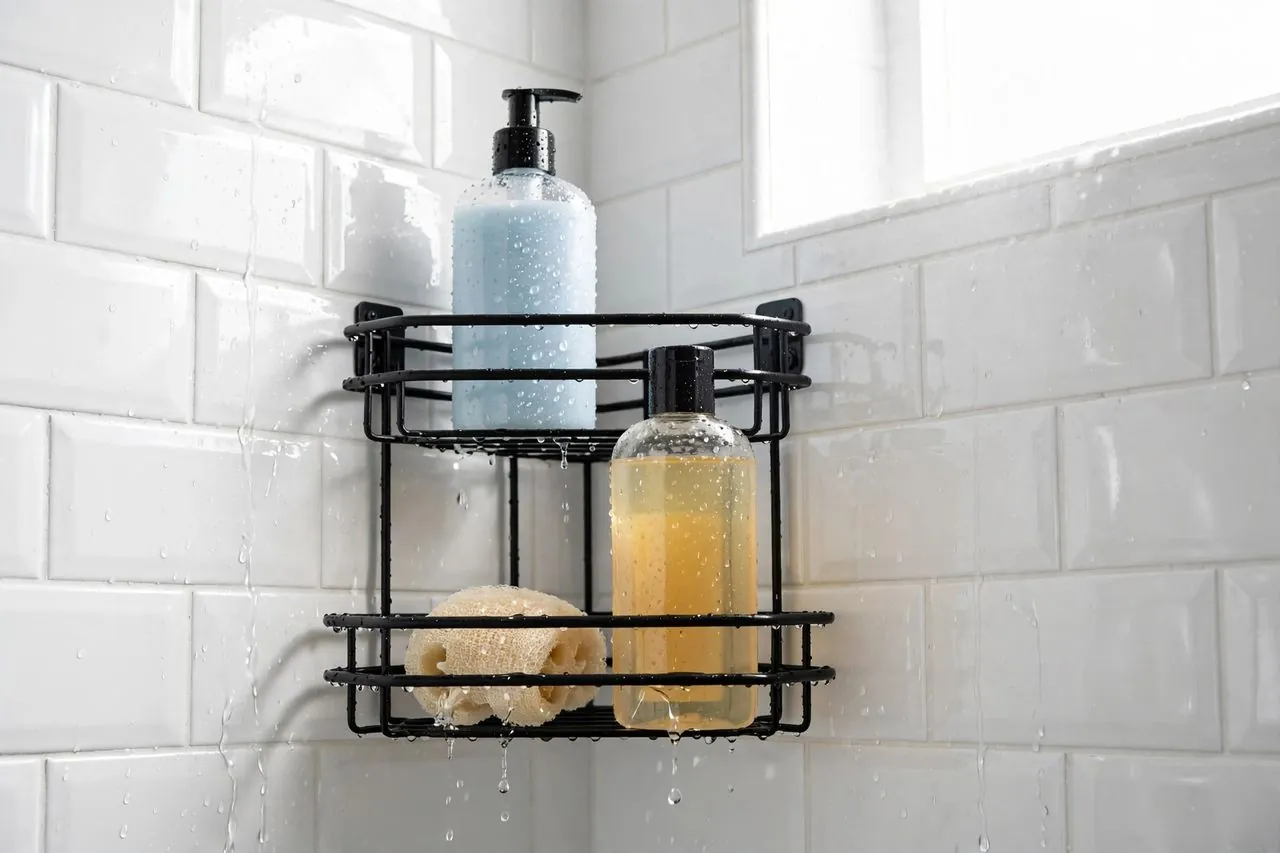
The best adhesive shower shelves are stainless steel or aluminium shelves on large, fresh pads, installed on smooth tile or glass that has been scrubbed, alcohol-wiped, kept clear of grout lines, and left unloaded for the full cure time stated on the pack. Most falls are install errors, not bad shelves.
In a hurry? Start with the first pick in the table below — it is the one most renters should look at first. Check Price on Amazon
Let us guess how you found this page. A shelf fell. Probably at night, probably with a crash that sounded much more expensive than it was, and probably about a week after you installed it and told someone the adhesive thing actually seemed to work. We know that story because it is the story behind nearly every adhesive shelf review, message, and late-night search on this topic — and because it happened to us, in a rented bathroom, with a full bottle of conditioner as the casualty.
Here is what we learned the slow way, and what this whole guide exists to teach: adhesive shower shelves do not usually fail because adhesive is weak. They fail because of five quiet causes — steam working on a bond that never fully cured, an invisible layer of soap film between the pad and the tile, texture the pad could never grip, a grout line running under the pad, and bottles loaded hours before the pack told you to load them. Every one of those causes is preventable. So this guide does two jobs. It recommends six shelf formats worth buying, and it teaches you the surface rules and the install sequence that decide whether any of them is still on your wall next year.
If you want the short version first: for a typical rental with a smooth-tiled corner, start with a two-pack of adhesive corner shelves in stainless steel, and install them exactly the way this guide describes.
Our honesty note, because this category needs one: we have not invented lab tests, load measurements, or star ratings anywhere in this guide. We chose these formats from published manufacturer specifications, the patterns in large volumes of owner reports, and clear reasoning about how adhesive bonds behave in a wet room. Where a pack states a load rating, treat that stated rating as the ceiling to plan under — and match it to your real bottles, on your real wall. Our full approach is on the How we review page, and this guide sits inside our Bathroom hub alongside its companion, the broader best no drill shower caddy comparison, for readers whose walls rule adhesive out entirely.
The decision table: six adhesive shelf formats compared
| Pick | Best for | Type | Key constraint | The catch |
|---|---|---|---|---|
| Adhesive corner shelves, 2-pack | Most renters, small showers, shared bathrooms | Adhesive corner | Needs a true right-angle corner and pads that sit flat without crossing grout | Our top pick still wastes its talent on rounded corners, and a bad first placement wastes a pad |
| Straight adhesive shelves, 2-pack | Flat feature walls, beside the controls, over the tub | Adhesive straight | Needs one wide, flat, smooth run of wall at reach height | Protrudes into elbow space on the wrong wall, and offers no corner protection for bottles |
| Adhesive shelves with hooks and a rail | Anyone whose clutter is razors, loofahs, and washcloths | Adhesive with hooks and rail | Hooks and rail add leverage, so the pad area must be generous and perfectly placed | The most useful format is also the easiest to overload with hanging weight far from the wall |
| Rust-proof aluminium adhesive shelf | Hard-water homes, rust worriers, lighter routines | Adhesive aluminium | Needs the same smooth surface as every adhesive pick, with no exceptions for the metal | Aluminium solves rust, not physics; it can dent, and it will not rescue a textured wall |
| Stainless steel adhesive shelf set | Full family-size bottles and the longest service life | Adhesive stainless steel | Needs the strongest, cleanest bond on this page, because the shelf itself is heavier | The strongest shelf asks the most of the pad, so sloppy prep is punished fastest here |
| Plastic adhesive shelf and soap dish set | Guest bathrooms, kids, short lets, and the cautious | Adhesive plastic | Needs realistic loading; best kept to light bottles, soap, and small items | Flexes under real weight, ages in heat, and is the format most likely to be oversold by its listing |
Notice what is not in this table: a single winner for every bathroom. Adhesive is a system — pad, surface, prep, cure, and load — and the format is only one part of it. The sections after the picks are where most of the value of this page lives, so even if you have already bought a shelf, read the install sequence before you open the pack.
Who this guide is for
This guide is for renters who cannot drill and want shelves that stay up, for anyone whose last adhesive shelf fell and who wants a real explanation instead of a refund shrug, and for careful buyers comparing aluminium, stainless steel, and plastic before they spend. It is also for you if your shower is part of a bigger rental plan — our renter-friendly bathroom storage guide connects the shower to the sink, door, and walls so everything works as one system, and our best no-drill shelves roundup covers the same thinking outside the bathroom.
Who should skip adhesive shelves
Skip adhesive entirely if your shower walls are textured tile, tumbled or matte stone, painted drywall, or wallpaper, and you are not open to a different method. No pad, prep routine, or hopeful review changes what those surfaces are. Skip it too if every tile in your shower is smaller than a typical adhesive pad, because the pad will always cross grout. And skip it if you need the shelf loaded within the hour — adhesive rewards patience and punishes hurry like nothing else in the bathroom. Our best no drill shower caddy guide covers tension, hanging, over-door, and freestanding alternatives honestly, and our deposit hub explains why protecting the walls always outranks one more shelf.
Why adhesive shower shelves fall: the five real causes
Cause one is soap film, the invisible saboteur. Shower walls that look clean are usually coated with a thin layer of soap residue, shampoo overspray, and body oils, built up over hundreds of showers. An adhesive pad pressed onto that film is not stuck to your tile. It is stuck to a layer of soap, and soap is not a building material. This is why shelves fall a week in rather than a day in: the film slowly shears, a corner of the pad lifts, steam gets under the edge, and the rest follows. The fix is unglamorous — scrub the exact spot, rinse it, and finish with an alcohol wipe that strips what cleaner leaves behind.
Cause two is the grout line. A pad bonds by full, flat contact. Grout sits slightly below the tile surface, so any pad crossing a grout line is bridging a shallow valley, gripping strongly on the tile and not at all across the gap. That unsupported strip becomes the starting point for every peel. Small tiles multiply the problem, because a standard pad may cross two or three lines. Measure your tile against the pad before you buy, position pads wholly on single tiles where you can, and treat a pad that cannot avoid grout as a sign to choose a corner format with two smaller pads — or a different mounting method altogether.
Cause three is texture. Matte finishes, tumbled stone, rough ceramics, and orange-peel paint all look almost smooth and behave like a mountain range at the scale an adhesive pad cares about. Contact happens only on the peaks, which is a fraction of the pad, and moisture wicks into the valleys. Owners often describe this failure as the shelf sliding slowly down the wall over days — that slide is exactly what partial contact looks like. Glossy, smooth, non-porous surfaces are not a preference in this category. They are the entire mechanism.
Cause four is cure time, the most ignored instruction in the category. Fresh adhesive bonds build strength over hours, not minutes. A shelf that feels solid when you hang it may be at a fraction of its final hold, and loading it with three full bottles at that point — then steaming it in a hot shower the same evening — asks the young bond to do its hardest work at its weakest moment. Many falls blamed on steam are really this: steam was simply the last stress on a bond that was never allowed to finish forming. Whatever the pack states, treat it as a minimum, install when you can shower elsewhere, and let the shelf sit empty and unbothered for the full window.
Cause five is steam itself, and it is real — just slower than people think. A hot, unventilated bathroom keeps every surface damp for hours, softens pad edges over months, and encourages the film of residue that creeps under lifted corners. Steam rarely defeats a well-installed pad quickly. It defeats neglected ones gradually, which is why ventilation and a monthly wipe around the pads appear in our care advice. Run the fan, crack the door, and a good install in a steamy room will comfortably outlast a careless install in a dry one.
Surface by surface: where adhesive shelves hold and where they do not
Glossy ceramic and porcelain tile is the home surface for this category: smooth, non-porous, and rigid. If your tiles are large enough for the pad to sit within one tile, expect the best hold this method offers. Glass shower panels are equally kind, with one caution — check what is on the other side of the glass before you press hard, and position shelves so a fall, however unlikely, drops bottles into the shower rather than onto feet. Polished marble and smooth stone are generally suitable, but wipe gently and avoid aggressive cleaners on the stone itself, because the prep that adhesive loves and the prep that marble tolerates are cousins, not twins.
Smooth fiberglass and acrylic surrounds are a conditional yes. The surface is smooth enough, but some panels flex when pressed, and a flexing panel works a bond the way bending a card works a crease. Press your palm firmly where the shelf would go. If the panel gives noticeably, choose a lighter format, spread the load across two shelves, or use a method that does not ask the wall to be rigid. Glossy metal panels, where they exist, hold adhesive well and ask only for the same soap-film scrub as tile.
Now the honest no list. Textured tile of any kind: no. Matte stone and honed finishes: no, however flat they feel to a fingertip. Painted drywall inside a shower: no — the bond can out-grip the paint itself, which turns removal into a repainting job. Wallpaper and peel-and-stick coverings: no, for the same reason in reverse; the pad will hold the paper, and the paper will not hold the shelf. Bare plaster, concrete, and wood inside the wet zone: no. If your bathroom lives on this list, do not read it as bad news. Read it as directions to the tension, hanging, and freestanding options in our no-drill storage hub, where your surfaces are an advantage rather than a disqualification.
Best for most renters: Adhesive corner shelves, 2-pack
The corner two-pack is our first recommendation for the same reason it anchors our wider caddy guide: corners are free space. A corner shelf turns the one part of the shower you never occupy into storage, keeps bottles behind a guard rail where elbows cannot easily sweep them off, and — the detail adhesive fans should care about — splits its bond across two walls. Each pad carries part of the load, and the shelf geometry braces itself into the corner, which is why well-installed corner sets have the most forgiving real-world record of any adhesive format.
Look for stainless steel with an open wire or slatted base that drains freely, a raised rail tall enough to matter for pump bottles, and a pack that includes spare pads. Spare pads are the mark of a maker who understands renters: they let you correct a crooked first attempt and re-mount after a move. Two shelves also let you organize by routine or by person — hair products up top, body products below — which sounds like a small thing until two people share one shower for a year.
Surface rules specific to corners: the corner itself must be a true right angle. Many rental showers have rounded or coved corners, especially in fiberglass surrounds, and a rigid corner shelf cannot sit flush against a curve — both pads end up half-bonded. Check with your hand before ordering. Then check the grout map on both walls, because a corner pad needs a clean, flat landing on two surfaces, not one. If one wall is ideal and the other is tiled in tiny mosaics, a straight shelf on the good wall will out-perform a corner shelf straddling both.
The honest downsides: corner shelves hold a little less per shelf than a wide straight shelf, deep corners can swallow small bottles out of easy sight, and the format is the least repositionable of all — once cured, a corner set really wants to live in that corner. Plan its height with both users standing in the dry shower, because a shelf placed for one person's chest height is another person's forehead hazard in a tight stall.
Who should skip this one: anyone with rounded corners, mosaic tile on either wall, or a strong preference for one wide, open shelf over two smaller ones.
Best for flat walls and over-tub storage: Straight adhesive shelves, 2-pack
The straight shelf is the simplest format here and, on the right wall, the most satisfying. Mounted on a flat run of tile beside the controls or on the long wall over a tub, it lines bottles up in a single visible row — nothing hides behind anything else, which quietly ends the knock-three-bottles-to-reach-one routine. A two-pack lets you run a daily shelf at reach height and a second, lower-duty shelf for the weekly products, or give each person in a shared bathroom a row of their own.
Choose a shelf with a guard rail across the front, drainage that does not depend on the shelf being perfectly level, and pads positioned at both ends of the shelf rather than a single central pad, because two end pads resist the twisting force of an off-centre heavy bottle far better. Stainless steel is our default material recommendation for straight shelves precisely because the format invites you to line up your heaviest bottles in a row; the shelf should not flex when you do.
Surface rules: you need a genuinely flat run of wall at least as wide as the shelf plus a little grace, with pads landing fully on tile or glass and clear of grout at their top edge especially — the top edge of a pad is where peel begins, so it deserves the cleanest contact. Avoid placing straight shelves on the wall you lean against or brush past in a narrow stall. A corner protects its bottles from you; a straight shelf relies on placement, so put it on the wall beside the controls rather than the wall behind your back.
The honest downsides: straight shelves protrude into the shower's movement space more than any other format, and in a slim stall that cost is paid daily in small elbow collisions. They also show clutter honestly — a corner basket hides a little chaos, a straight row displays it. And because the format tempts you to line up everything you own, it is the easiest shelf to overload beyond what its pads were promised to hold.
Who should skip this one: anyone in a narrow stall, anyone whose only flat wall is the one they stand against, and anyone who knows their shelf will become a full product archive rather than a daily row.
Best for razors, loofahs, and small clutter: Adhesive shelves with hooks and a rail
Ask what actually makes a shower look messy and the answer is rarely the bottles. It is the small things — razors balanced on edges, a loofah draped over the showerhead, a washcloth on the taps, a squeegee on the floor. This format exists for them: a shelf for bottles, a rail beneath it for a cloth or a small towel, and a row of hooks for everything that hangs. Bought well, it replaces three separate organizers with one footprint and one set of pads to install carefully.
Look for hooks that are fixed or lock into place rather than loose hooks that slide and rattle, a rail that sits close under the shelf rather than jutting out, and — most important — pad area that is visibly generous for the shelf size. Hanging items pull outward as well as downward, and that outward leverage is harder on a bond than the same weight sitting in the basket. A maker who understands this gives the format bigger pads; a maker who does not gives it prettier photos. Choose accordingly, and hang the heaviest hook item nearest the wall mount, not at the far end of the rail.
Surface rules match the rest of this guide, with extra respect for placement. Because this shelf works hardest at its bond, give it your best wall: the flattest, smoothest, largest-tiled spot in the shower, out of the heaviest direct spray if possible. Keep bar soap in a draining dish on the shelf rather than on the rail, where a wet bar becomes a sliding weight at the worst leverage point.
The honest downsides: this is the easiest format to overload without noticing, because each hook item feels weightless on its own. It is also the format most likely to be installed too low, where hanging cloths stay permanently damp against the wall. Mount it so hanging items clear the tub edge or shower floor comfortably, and let air do its work. Finally, households with small children should think about hook height and razor placement with adult honesty — the best storage puts razors up, separate, and boringly out of reach.
Who should skip this one: minimalists whose routine is three bottles and nothing else, and anyone whose best wall space is limited, because this format deserves the premium spot or none at all.
Best for beating rust: Rust-proof aluminium adhesive shelf
If your last caddy died of orange streaks rather than a fall, aluminium is your material. Aluminium does not rust in the way steel does; it forms a dull protective layer and gets on with its life, which is why anodized aluminium is the quiet hero of wet-room design. An aluminium adhesive shelf is also noticeably lighter than a steel one, and that lightness is a genuine adhesive advantage: before you add a single bottle, the shelf itself is asking less of the bond. For a modest daily routine — shampoo, conditioner, body wash, one or two extras — that margin is real.
Look for anodized rather than painted finishes where the listing states it, drainage slots rather than a solid tray, and edges that are folded or finished rather than raw-cut. Aluminium shelves often use a clean, flat, modern profile, which suits the small, calm bathroom many renters are trying to build — the same instinct behind the wider ideas in our small apartment hub. Check that the pads supplied are sized for the shelf and that replacements are available, because an aluminium shelf can easily outlive two or three tenancies and several sets of pads.
Surface rules are unchanged, and we will say it plainly because aluminium marketing sometimes implies otherwise: the metal solves corrosion, not adhesion. The pad still needs smooth tile or glass, a grout-free landing, the alcohol wipe, and the full cure. What aluminium does buy you in a hard-water home is forgiveness on the shelf itself — limescale wipes off an anodized surface without the pitting that eventually roughens cheaper coatings, and a smooth shelf keeps bottles sliding less and sitting cleaner.
The honest downsides: aluminium can dent where steel would shrug, so it dislikes being the household shelf for the heaviest family-size bottles. It also tends to cost more than basic plastic and plated options for the same footprint, and its lighter feel can read as less substantial in the hand even when it performs perfectly on the wall. Judge it after the cure, loaded, not in the unboxing.
Who should skip this one: anyone whose routine is built around several very large, heavy bottles, and anyone expecting aluminium to make a textured wall work — it will not.
Best for heavy bottles and long service: Stainless steel adhesive shelf set
Stainless steel is the heavyweight of this guide in both senses, and for households whose bottles are big, glass-free, and numerous, it is the right heavyweight. A well-made steel shelf does not flex when a full family-size bottle lands at its front edge, its wire or bar construction drains completely, and a stated steel grade in the listing is one of the most reliable quality signals in the whole category. Multi-piece steel sets — two shelves, a soap dish, sometimes a toothbrush holder — let you distribute a serious routine across several bonds instead of asking one pad to hold a person's entire shelf of products.
That distribution is the real skill in using this format. Spread the load by routine: daily bottles on the main shelf at reach height, the soap dish and lighter items on their own smaller mounts, weekly treatments on a second shelf. Each mount then lives comfortably within the rating its pack states, with margin to spare — and margin, in adhesive land, is what survives the steamy week when the bathroom fan breaks. Weigh your two heaviest bottles together once, honestly, and let that number choose your shelf size rather than the other way around.
Surface rules reach their strictest here, because a steel shelf starts heavier and invites heavier loading. Give this pick your single best section of wall: large smooth tiles, pads clear of grout on every edge, scrubbed and alcohol-wiped, cured for the full stated window and then some if your schedule allows. If your bathroom cannot offer that wall, the honest move is a lighter aluminium format or a tension pole from our no-drill caddy guide — not a steel set installed hopefully on a mediocre surface.
The honest downsides: steel shows water spots more readily than matte aluminium, so it asks for a weekly wipe to look its best. The sets cost more than the plastic and plated alternatives, and the weight that makes them feel premium makes a fall louder and more consequential if prep was skipped. This format rewards careful installers more than any other on this page, and punishes careless ones the fastest.
Who should skip this one: anyone with a small or doubtful wall surface, anyone in a very short let where the investment will not pay back, and anyone who plans to skip the cure time — with steel, that shortcut has the shortest fuse.
Best for guests, kids, and short lets: Plastic adhesive shelf and soap dish set
Plastic gets a poor reputation in this category, mostly because listings dress it in promises it cannot keep. Used honestly, it has a real job: light shelves for light things, in the places where light things are all you need. A guest bathroom that hosts a bottle or two at a time. A child's shower, where unbreakable and quiet matters more than capacity — a plastic shelf dropped in a tub makes a clatter, not a crisis. A short let or a first apartment, where the correct budget for shower storage is a small one and the tenancy might end before a steel set earns its keep.
Look for thicker, rigid plastic with a stated shape rather than thin flexible trays, drainage holes that are actually open rather than decorative dimples, and a soap dish that keeps the bar raised and dry, because a bar sitting in its own puddle is the fastest route to a slimy shelf in any material. Treat every load claim on a plastic listing with friendly suspicion and plan to use a fraction of it: soap, a razor, one modest bottle per shelf is the honest working load for most of these sets, whatever the headline says.
Surface rules still apply in full — plastic is lighter, not magic — and heat deserves a mention: very hot, sunlit, or sauna-steamy bathrooms age plastic faster, making it brittle over time. Position plastic shelves out of the most punishing direct spray where you can, and check them at each pad wipe for the fine cracks that say a shelf is ready to retire gracefully rather than mid-shower.
The honest downsides are the mirror of its virtues. It flexes, and flex works on bonds. It ages in heat. It will not grow with a routine that becomes a collection. Buy it as the right tool for a light job, at a light price, with light expectations, and it is a perfectly respectable pick. Buy it as a family bottle store and you have scheduled the 2 a.m. crash this guide opened with.
Who should skip this one: anyone storing multiple full-size bottles, anyone in a very hot and steamy bathroom, and anyone who wants a buy-it-for-years shelf.
The install sequence that actually holds: step by step
Here is the sequence, in order, with nothing skipped. Step one: plan the position standing in the dry shower, bottles in hand, and mark the pad positions lightly in pencil. Check each pad's full footprint against the tiles — no grout under any edge, no texture, no flex in the panel. Step two: scrub those exact spots with bathroom cleaner and a non-scratch pad, because you are removing soap film, not dust. Step three: rinse the area and dry it completely with a clean cloth, then wait a few minutes more; tile that feels dry can still hold moisture in its surface texture. Step four: wipe each spot with the alcohol pad supplied or rubbing alcohol on a cloth, and let it flash off fully. Do not touch the cleaned area with your fingers afterwards — the oil from one fingertip is a small version of the film you just removed.
Step five: peel, position once, and press. Adhesive pads reward one confident placement. Press firmly across the whole pad for the full time the maker states, working from the centre outward to push air out rather than trapping it. Step six: attach the empty shelf and check it sits level and flush. Step seven, the one that decides everything: wait the full cure time stated on the pack before loading anything, and keep showers elsewhere during that window if you possibly can. Step eight: load gradually — light items first, heaviest bottles last, heaviest bottles closest to the wall — and for the first week, glance at the top edges of the pads when you shower. A top edge lifting early is a fixable warning if you unload and re-press; ignored, it is next week's fall. If you are setting up shelves beyond the shower too, the same sequence governs every adhesive product in our peel-and-stick hub: surface, scrub, alcohol, patience.
Steam management and monthly care
You cannot remove steam from a shower, and you should not try. What you can do is shorten the time your bathroom stays saturated. Run the extractor fan during your shower and for a while after, or open the door when the fan is weak or absent — a bathroom that dries between uses is the single kindest environment for every adhesive bond in it. Position shelves slightly out of the heaviest direct spray when your layout allows, because a pad edge that is not being driven with hot water daily keeps its seal longer.
Monthly, give the shelves five honest minutes. Wipe the shelf surfaces so soap film never becomes a permanent slick. Wipe around — not under — the pads, and press each pad once, firmly, the way you did on install day, which re-seats edges that daily steam has been patiently testing. Check bottles for the soapy rings that glue them to shelves, and wipe their bases too. That is the whole ritual. Owners whose shelves last for years are rarely using secret products; they are doing these five minutes and wondering what the fuss was about. More wall-friendly routines like this run through our whole Bathroom section, because the bathroom is where renters win or lose their deposits in slow motion.
Mistakes and red flags: what not to buy
Refuse any listing that claims one shelf holds an enormous load on any surface with no cure time — three boasts, each disqualifying the others. Refuse packs with no spare pads and no stated pad dimensions, because both omissions tell you the maker never imagined a renter measuring a tile. Be wary of metal described with adjectives instead of a material — premium, heavy-duty, and space-grade are weather reports, not specifications. Be wary of the opposite trick too: a real material name paired with no drainage, because a solid tray of standing water will age any shelf and stress any bond.
The install mistakes matter more than the shopping ones. Never install straight after a shower, when the room and walls are warm and damp. Never install over a freshly cleaned but still wet wall because you are in a hurry to finish. Never test a fresh shelf by hanging your full weight of bottles on it an hour in, just to see. Never place a pad half on tile and half on grout and call it close enough. And never, in a rental, upgrade a struggling pad with construction adhesive or permanent glue to make it stay — that converts a removable shelf into wall damage, and wall damage is the exact thing every product in this guide exists to avoid. If a surface defeats adhesive, change methods, not chemistry.
Removal and protecting your deposit
Removal day is where this category earns its renter-friendly name — if you give it the same patience you gave the install. Warm one pad at a time with a hairdryer on a low or medium setting, moving slowly around its edges for a minute or two, until the adhesive visibly softens and relaxes. Then start at one corner and peel slowly, folding the pad back flat against the wall as you go, so the force travels along the surface rather than pulling out from it. If resistance rises, stop, add warmth, and continue. The whole pad should release without ever being yanked.
Residue is normal and almost never damage. Most of it rolls away under your thumb with a little patience. What remains usually lifts with a small amount of adhesive remover on a cloth — test it first in a hidden corner, keep it brief on natural stone, and never bring a metal scraper near tile glaze or fiberglass; a plastic scraper, used flat and gently, is the strongest tool this job should ever need. Wash the area with normal bathroom cleaner afterwards, dry it, and look at it once in daylight and once under the bathroom light, because residue that hides in one light announces itself in the other.
Then do the renter's closing ritual: photograph the clean wall from your move-in angles, note the date, and move to the next room with our deposit hub checklist open. If the next home gets adhesive shelves too — and installed this way, we suspect it will — start again at the planning step, check its surfaces against the rules in this guide, and browse the companion best no drill shower caddy comparison if its walls argue for a different method. Good adhesive work is invisible twice: once while it holds your bottles for years, and once when it leaves no trace that it was ever there.
Frequently asked questions
- Why do adhesive shower shelves keep falling down?
- Almost always for one of five reasons: soap film left on the tile under the pad, a grout line crossing the pad, a textured or matte surface the pad could not grip, bottles loaded before the full cure time passed, or a load heavier than the rating stated on the pack. Fix the cause that matches your bathroom and the same style of shelf usually holds well.
- How long do adhesive shower shelves need to cure before I use them?
- Follow the time stated on your pack exactly, and treat it as a minimum rather than a suggestion. Keep the shelf empty for the whole window and shower elsewhere if you can, because steam and weight during curing weaken the young bond. If the pack gives no time, wait a full day before loading and longer before adding your heaviest bottles.
- Can adhesive shower shelves work on textured tile?
- No, and this is the rule with the fewest exceptions in this guide. Texture means the pad touches only the raised points of the surface, so most of its area never bonds, and moisture collects in the gaps. Shelves on textured tile typically slide or fall within weeks. Choose a tension pole, hanging, or freestanding caddy instead, and save adhesive for a smooth surface.
- Do adhesive shower shelves damage tile when removed?
- On glazed tile or glass, correctly removed adhesive shelves should not cause damage. Warm the pad with a hairdryer until it softens, peel slowly while folding the pad back against the wall, and roll off residue with your thumb. Damage usually comes from yanking a cold pad or scraping with metal tools. Never use this method on painted walls, where the paint layer itself can lift.
- What surfaces are best for adhesive shower shelves?
- Smooth, non-porous, and rigid surfaces hold best: glossy ceramic or porcelain tile, glass panels, polished stone, and smooth metal. Each pad needs to sit fully on one continuous surface without crossing a grout line. Smooth fiberglass can work if the panel does not flex when pressed. Matte, textured, painted, and papered surfaces are not suitable, whatever the listing suggests.
- How much weight can adhesive shower shelves hold?
- Only the rating stated on your specific pack can answer that, so read it before you buy and plan to stay comfortably under it. Weigh your two heaviest bottles together and let that number guide your choice. Keep heavy bottles lowest and closest to the wall, spread a large routine across two shelves, and remember that hooks and rails add outward pull as well as weight.
- Will steam from hot showers loosen adhesive shelves?
- Steam alone rarely defeats a well-installed shelf quickly, but months of steam in an unventilated bathroom will soften pad edges and feed residue under any lifted corner. Run the fan or open the door after showering so the room dries fully, wipe around the pads monthly, and press each pad firmly once a month to re-seat its edges.
- Can I reposition an adhesive shower shelf after sticking it?
- Not with the same pad. Once a pad has been pressed and peeled, its bond is spent, and reusing it is a reliable way to schedule a fall. This is why we recommend packs that include spare pads. Plan the position standing in the dry shower, mark it in pencil, and commit once. If a shelf must move, remove it fully and start with a fresh pad.
- Are aluminium or stainless steel adhesive shelves better?
- Aluminium is lighter, which is gentler on the adhesive bond, and it does not rust, so it suits modest routines and hard-water homes. Stainless steel is stronger and stiffer under heavy family-size bottles, but the shelf itself weighs more and asks more of the pad. Choose by your bottles: light routine, aluminium is a pleasure; heavy routine, steel earns its demands.
- Why did my shelf fall after months of holding fine?
- A late fall usually means a slow process finished, not a sudden failure. Soap film creeps, a pad edge lifts a little more each week, steam works into the gap, and one warm night completes the story. Monthly care prevents most late falls: wipe around the pads, press them firmly to re-seat the edges, and unload and re-mount any shelf whose top edge has visibly lifted.
- Can I put adhesive shelves over the bathtub instead of in the shower?
- Yes, and it is often the kindest placement in the room. The wall above a tub usually gets less direct spray and less steam than the shower walls, so bonds live calmer lives there. The same rules still apply: smooth surface, no grout under the pads, full cleaning and alcohol wipe, and the full cure before loading. Reach from the tub safely before you commit to a height.
- What should I do if my tiles are smaller than the adhesive pads?
- Measure one tile and compare it honestly with the pad size in the listing before ordering. If the pad must cross grout lines, its hold will be unreliable however carefully you install it. Look for corner formats with smaller separate pads, choose narrower shelves designed for small tiles, or switch to a tension or hanging caddy that does not depend on the wall at all.
- How do I clean adhesive shower shelves without loosening them?
- Clean the shelf, not the bond. Wipe shelf surfaces with a soft cloth and normal bathroom cleaner, and wipe around the pads rather than soaking or prising at their edges. Never scrub under a pad edge and never use a steam cleaner directly on the mounts. A monthly press on each pad after cleaning re-seats edges and takes less than a minute per shelf.
- Are plastic adhesive shower shelves worth buying?
- Yes, for the light jobs they are honestly suited to: a guest bathroom, a child shower, a soap dish and one modest bottle, or a short let with a small budget. They fail when listings or owners ask them to store a full family routine. Buy plastic with light expectations and it performs respectably; buy it as a heavy-duty shelf and it will disappoint on schedule.
- Can adhesive shelves hold a full litre shampoo bottle?
- Some can, but the pack rating and your surface decide, not the bottle alone. A large full bottle is the heaviest common item in a shower, so place it lowest, closest to the wall, and ideally on a shelf whose stated rating leaves clear margin after everything else is counted. If the maths feels tight, split the routine across two shelves or decant into a smaller bottle.
- What is the best adhesive shower shelf for a small shower?
- A corner two-pack is usually the best use of a small shower because the corner is space you never stand in, and two modest shelves stay tidier than one crowded basket. Mount the main shelf at the reach height of the shortest regular user, keep the heaviest bottles on it, and use the second shelf for lighter weekly items so the corner never becomes top-heavy.
- How do I remove stubborn adhesive residue from tile?
- Start with warmth and your thumb, which removes more residue than most people expect. For what remains, use a small amount of adhesive remover on a cloth, tested first in a hidden spot, and a plastic scraper held flat and used gently. Avoid metal tools on glaze and avoid soaking grout for long periods. Finish with normal bathroom cleaner and a dry cloth.
- Should I install adhesive shelves before or after deep cleaning the bathroom?
- Install them as the final step of a deep clean, not before it. The scrub and alcohol wipe in the install sequence are targeted versions of cleaning, and a freshly deep-cleaned, fully dry wall gives you the best starting surface. Just make sure no cleaning product residue remains on the exact spots, because a film of cleaner under a pad is the same problem as a film of soap.
- Can I use adhesive shower shelves in a rented apartment without risking my deposit?
- Yes, when three conditions are met: your lease allows removable adhesive products, your surface is smooth tile or glass rather than paint, and you remove the shelves slowly with heat at move-out. Photograph the walls at install and after removal. If your lease bans adhesives or your walls are painted, choose a hanging or freestanding caddy and keep the deposit out of the conversation entirely.